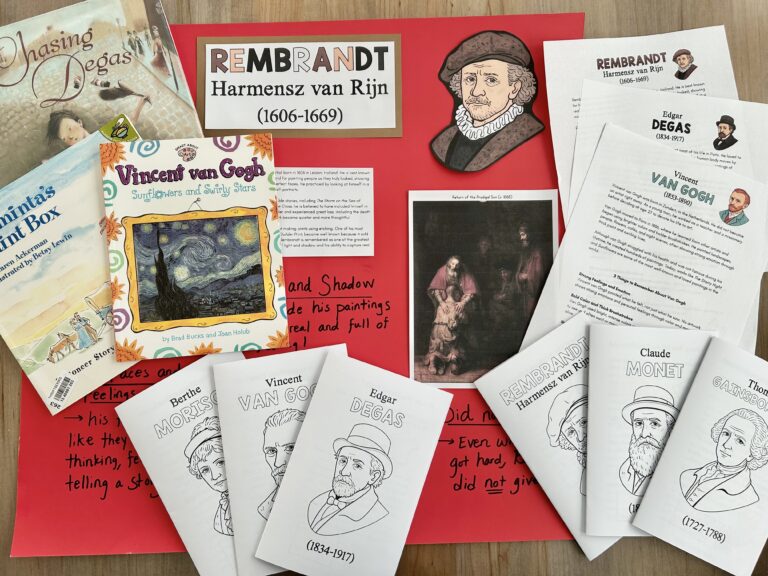
Exploring Orchestra and Composers in Classical Conversations Cycle 1

This post contains affiliate links, which means I make a small commission at no extra cost to you. See my full disclosure here.
Are you new to the Classical model and want to know more about it? Keep reading below about how it’s organized, the cycle rotation, and the different aspects of fine arts in the curriculum.
If you already know about the Classical homeschooling model and you are ready to jump to the orchestra plans and activities, click here.
A Classical model of homeschooling
We are part of a Christ-centered homeschool program that follows the Classical model. The younger children, ages 4-12, focus on a memorization-based curriculum which acts as the groundwork of learning that is built upon in later years.
Children and their parents learn key facts across the core subject areas including history, science, English, mathematics, geography, and Latin. Tutors use fun activities, games, songs, and lots of energy to introduce the new material. The parents can then expand on that material at home throughout the week.
Cycle rotation
The material is divided into three cycles, which each last one year. The cycles continue to rotate every three years, so most children who start when they are kindergarten age, complete each cycle at least twice. This allows them to develop a deeper comprehension and grasp of the material through repetition.
Fine Arts
Fine Arts is an important part of the Classical curriculum that is focused on each Cycle. Every six weeks students focus on a different aspect of fine arts, allowing them to explore a variety of artistic disciplines throughout the year. The first six weeks are dedicated to drawing, where students learn basic skills that build confidence and encourage observation. The next six weeks focus on the tin whistle, providing an introduction to music theory and practice. Beginning second semester, the curriculum shifts to great artists, where students study famous works and techniques, deepening their appreciation for art history. Finally, the last six weeks are devoted to composers and orchestra, giving students a glimpse into the world of classical music.
Following is how our community teaches about orchestra during the last 6 weeks. You may use these ideas if you are also in a Classical homeschooling community, or if you’re a parent who is looking for music theory ideas to use at home.
Also, you don’t have to be part of any particular Classical homeschooling group to use these ideas! These are ideas to help children learn the basics about orchestra and composers. If you are a homeschooling parent, or just a parent who wants to help introduce your children to music, these ideas will be helpful for you.
Community group time
Our homeschooling community has been meeting on Tuesdays. Our leader starts off the morning with everyone together in a big group setting. She typically begins that time with a devotional reading and prayer, and then continues with some announcements, celebrating birthdays, the pledge of allegiance, and anything else she wants to cover with everyone.
After this time, we split off into our different groups based on age. The tutors lead their groups into different classrooms and begin the New Grammar part of the day. This is when the tutor introduces the memory work for each core subject. Check out my post and video about how to make your own tutor board!
After this is when we usually focus on fine arts and do a science experiment. Sometimes we do this altogether as a whole community, and sometimes we stay in our smaller groups. During the six weeks that we focus on orchestra and composers, we stay together as a whole community.
We start learning about the orchestra and several composers at the beginning of the fourth quarter (or week 19) of the school year. Read along as I take you through how our community teaches the kids about orchestra and some composers, specifically during the Baroque and Classical periods in Cycle 1.
Week 19: Baroque and Classical Periods Introduction
Baroque and Classical Periods
We begin our study of the orchestra as our director introduces the Baroque and Classical periods to the kids. She shows the kids how a Baroque or Classical orchestra is set up differently than how an orchestra is set up today.
Building an Orchestra
Our director talks to the children about the four families of instruments: strings, woodwinds, brass, and percussion. Then the students help build an orchestra seating chart. They work together to place laminated instrument pictures on a whiteboard in the correct spots. This helps them see where each group of instruments sits. This activity is a great way to introduce the children to the different instruments and give them a visual of an orchestra!
Week 20: Orchestra Overview
Bring Your Instrument!
This is the week when the children get to bring in any instruments they have at home! Some of the older students present about their instrument to the rest of the group. Parents can bring in instruments and share about them too! This is a great way for the children to see and touch (gently) actual instruments.
Orchestra Song
Next, we teach the children the orchestra song. Each group of students is assigned to an instrument family. We sing the song as a round, which helps them remember the names and sounds of the instruments. It’s a fun and active way to start learning about the orchestra!
Weeks 21-23: Cultivating Restful Listening
For the next three weeks, we focus on helping students enjoy music through restful listening. Each week, the children get to meet a different composer! One of the older children or a parent dresses up as one of the composers and a tutor interviews them in front of the whole community. This allows everyone to learn all about each composer including how they became composers, how many pieces of music they wrote, etc. The kids absolutely love this and it’s so fun to see the composers come to life!
After the interview, we listen to a piece by the composer. Before we begin, we turn off the lights and have the students lie down with sleeping bags or blankets. Some bring in a stuffed animal to snuggle. We give them eye masks so they can focus on listening without using their eyes.
Then we play the music while everyone listens quietly. After the music ends, we ask the students what they noticed. During our smaller group time, the tutor plays the music again and has the kids follow along using flow charts of the song. You can find these flow charts here.
Week 21: Handel (Water Music Suite no. 2)
During week 21, we focus on Handel and his Water Music Suite no. 2. Some fun facts that the children learn about Handel during his interview are:
- He was an English composer
- He composed very quickly. He wrote the Messiah in less than three weeks!
- He was very passionate about his work and had a temper.
- His famous piece is the Messiah (Hallelujah!).
- He went blind in his old age.
Week 22: Bach (Well-Tempered Clavier)
During week 22, we focus on Bach and his Well-Tempered Clavier. Some fun facts that the children learn about Bach during his interview are:
- He became an orphan at 10 years old.
- He had 20 children!
- He used music to tell stories.
- He is considered one of the greatest composers of all time.
- He is considered to be the last Baroque composer.
Week 23: Mozart (“Piano Concerto no. 22 in E-flat, Third Movement”)
During week 23, we focus on Mozart and his “Piano Concerto no. 22 in E-flat, Third Movement.” Some fun facts that the children learn about Mozart during his interview are:
- He wrote music before he wrote words.
- He performed throughout Europe as a child.
- He had an incredible mind for music.
- He wrote over 600 pieces of music.
- He was a Classical composer.
Week 24: Review and Celebration
During Week 24, we like to end our composer study with something fun and memorable. We watch a short orchestra-themed video, like Peter and the Wolf. This story helps students hear how each instrument can represent a different character. It brings the orchestra to life in a fun and creative way.
As they watch, students get to point out the instruments they’ve learned about. It’s a great way to wrap up the six weeks and celebrate all they’ve learned. We also make popcorn for the kids to eat as they watch the film. The kids always enjoy this special treat, and it helps them remember the sounds and families of the orchestra.
Great Picture Books about the Orchestra
Picture books are a fun and gentle way to teach kids about the orchestra at home. Here are some of our favorite books to enjoy together:

How to Build an Orchestra by Mary Auld. This is a fun and colorful book that teaches kids about each section of the orchestra as a conductor puts it together. It explains instruments in a simple way and includes music to listen to as they learn!

A Child’s Introduction to the Orchestra by Robert Levine. This is an engaging book that introduces children to orchestral instruments and classical music through fun stories and illustrations.

A Is for Oboe: The Orchestra’s Alphabet by Lera Auerbach and Marilyn Nelson (Cycle 1 Week 19 Fine Arts). In this book, each letter of the alphabet highlights a musical instrument, or term, paired with poetic descriptions and beautiful illustrations. This is a great book for introducing children to music and the beauty of orchestras.

Never Play Music Right Next to the Zoo by John Lithgow, illustrated by Leeza Hernandez (Cycle 1 Week 19 Fine Arts). This is a story about a boy who attends a concert near a zoo. Chaos ensures when the animals escape and take over the orchestra, each playing an instrument with hilarious results.

Ada’s Violin: The Story of the Recycled Orchestra of Paraguay by Susan Hood, illustrated by Sally Wern Comport (Cycle 1 Week 19 Fine Arts). This is the true story of Ada Rios, a young girl from a poor community in Paraguay, and her journey to play in an orchestra using instruments made from recycled materials.

Mozart: The Wonder Child: A Puppet Play in Three Acts by Diane Stanley. This book tells the life story of Wolfgang Amadeus Mozart in the form of a puppet play. It captures Mozart’s extraordinary talent, his musical achievements, and the challenges he faced.
Instruments of the Orchestra Activity Book
If you’re looking for a simple and engaging way to introduce your children to orchestral music, my Instruments of the Orchestra Activity Book is a wonderful companion for your fine arts studies. This book includes 38 fun activities designed to help kids learn the main instruments of the orchestra in an interactive and approachable way.
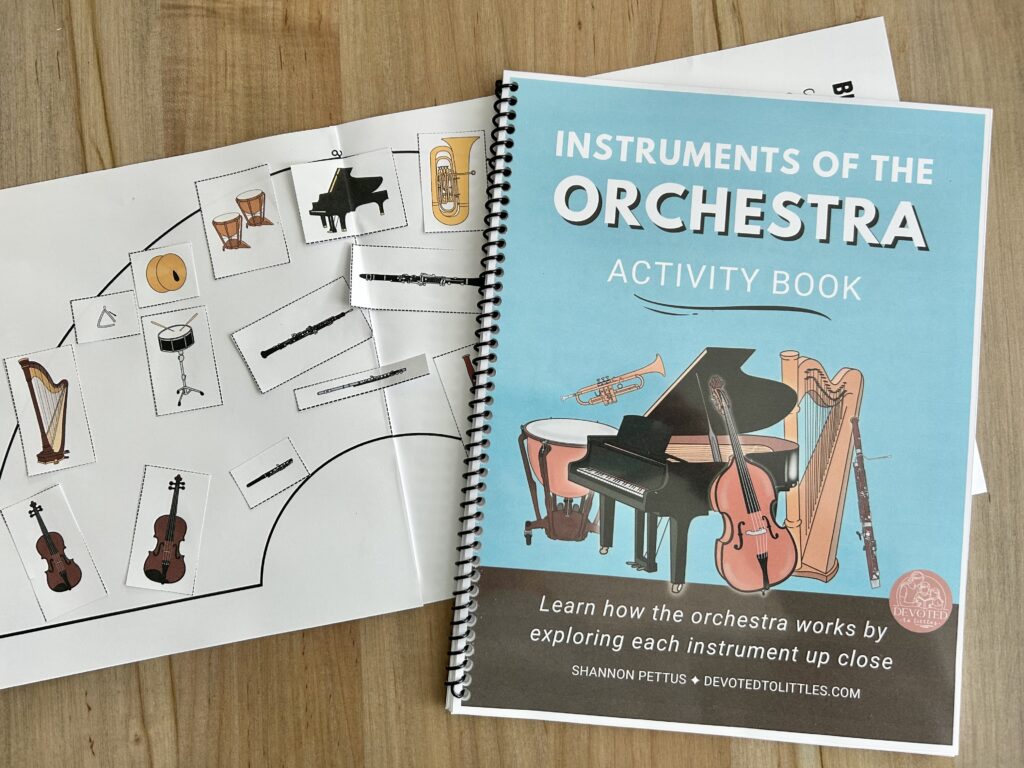
Children will explore all four instrument families—strings, woodwinds, brass, and percussion—and discover what makes each family unique. The activity pages guide them through the features and sounds of individual instruments, helping them understand how each one contributes to the orchestra as a whole.
The book also includes listening links for each instrument family so kids can hear real examples of these instruments in action, making the learning experience richer and more memorable. At the end, you’ll find kid-friendly book recommendations for families who want to continue exploring music and deepen their understanding of the orchestra.
Whether you use it during your fine arts block or simply want to nurture a love for music at home, this activity book keeps learning hands-on, enjoyable, and accessible for the whole family.

Instruments of the Orchestra UNO Card Game
To make learning even more fun, I also created an Instruments of the Orchestra UNO–style card game that families can play together. The deck includes colorful instrument cards from all four families—strings, woodwinds, brass, and percussion—along with themed action cards to keep the game exciting. It’s a playful way for kids to reinforce what they’re learning about orchestra instruments while practicing quick recognition and matching skills.

Print the cards on cardstock, laminate if you like, and you’ve got an easy, reusable game that brings music learning to life at the kitchen table.

Mozart: The Wonder Child: A Puppet Play in Three Acts by Diane Stanley. This book tells the life story of Wolfgang Amadeus Mozart in the form of a puppet play. It captures Mozart’s extraordinary talent, his musical achievements, and the challenges he faced.
FREE Instrument Family Posters
If your kids are learning about the orchestra this year, you’ll love this free set of four Instrument Family Posters! These beautifully illustrated posters highlight the strings, woodwinds, brass, and percussion families and are perfect for hanging in your homeschool room, slipping into a morning basket, or adding to your fine arts lessons.

They’re bright, simple, and kid-friendly—designed to help children quickly recognize each family and remember the main instruments that belong to it.
To download your free set, just enter your email in the form below and I’ll send them straight to your inbox!
They make a wonderful companion to any orchestra study and pair perfectly with Weeks 19–24 of Classical Conversations® Fine Arts.
Great Artists Display Board
I also wanted to share a fun way our community displays each child’s artwork from Weeks 13-18. We purchase a black display board for each child and attach their artwork from each week when we learn about Great Artists. I also made a display title for each of the artists with the artist name, week, and years of life. You can download these display titles for each of the six great artists here: Great Artists Display Board Title Pages. I also uses these letter stickers to write the first and last name of each child along the sides of the main part of the display board. See the picture below.

We set these display boards up during our end-of-year ceremony. It’s really special for the kids to be able to see all of their artwork, and for the other parents to be able to walk around and observe it as well!
If you try any of these Cycle 2 orchestra resources, I would love to see what you’re doing!
Tag me on Instagram so I can cheer you on and share your ideas with other families.
Happy music-making, friend! 🎻✨