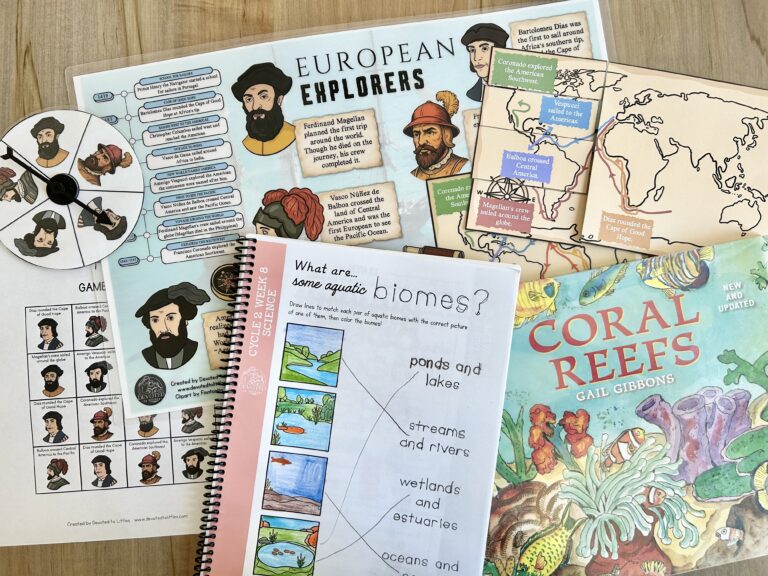
Am I Doing Enough as a Homeschool Mom? A Look Inside Our Cycle 2 Week 18 Rhythm
A Look Inside Our Simple Daily and Weekly Rhythm During Cycle 2 Week 18
If you have ever wondered, “Am I doing enough?” as a homeschool mom, you are not alone. When I first started homeschooling, I did not know what curriculum to choose or how much work we should actually be doing each day. Over the past few years, I have learned so much through trial and error, and today I want to share what our daily and weekly rhythm looks like during Cycle 2 Week 18 of Classical Homeschooling.
Even though I am sharing examples from this specific week, our rhythm stays very similar from week to week. The details change, but the structure and priorities remain the same — and that consistency is what keeps our homeschool simple and peaceful.
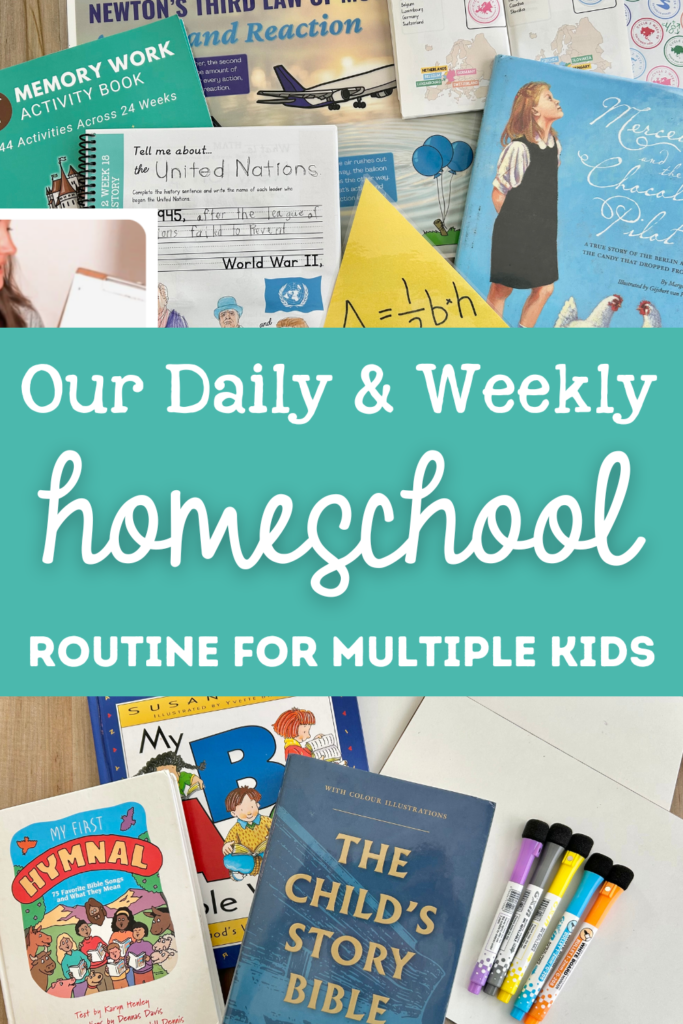
My hope is that seeing a real snapshot of our week encourages you that homeschooling does not need to be complicated. It can be calm, doable, and centered around what matters most in your home and your season.
This post contains affiliate links, which means I make a small commission at no extra cost to you. See my full disclosure here.
A Simple Habit That Changed Everything: Preparing the Night Before
The biggest thing that makes our mornings smoother is taking just a few minutes the night before to prepare the space. I clear off the kitchen table and set out anything we will need for the next day. If it is a geography day, I put out our geography resources. If it is Monday, I place our The 24 Family Ways coloring books on the table. I also set out our Bible and whatever my oldest will need for her morning math lesson.
This tiny ritual removes the morning scramble and brings such a sense of calm to the start of our day.
As I walk through our routine below, I will also share a few examples from the Cycle 2 Week 18 memory work that we are working through right now so you can see how this plays out in real time.
I also keep a rolling homeschool cart in the pantry. Each of my older girls has her own shelf where their books for math, language arts, handwriting, and other materials live. When I ask them to get their math, they know exactly where to go. This keeps our table uncluttered and gives them a sense of independence.
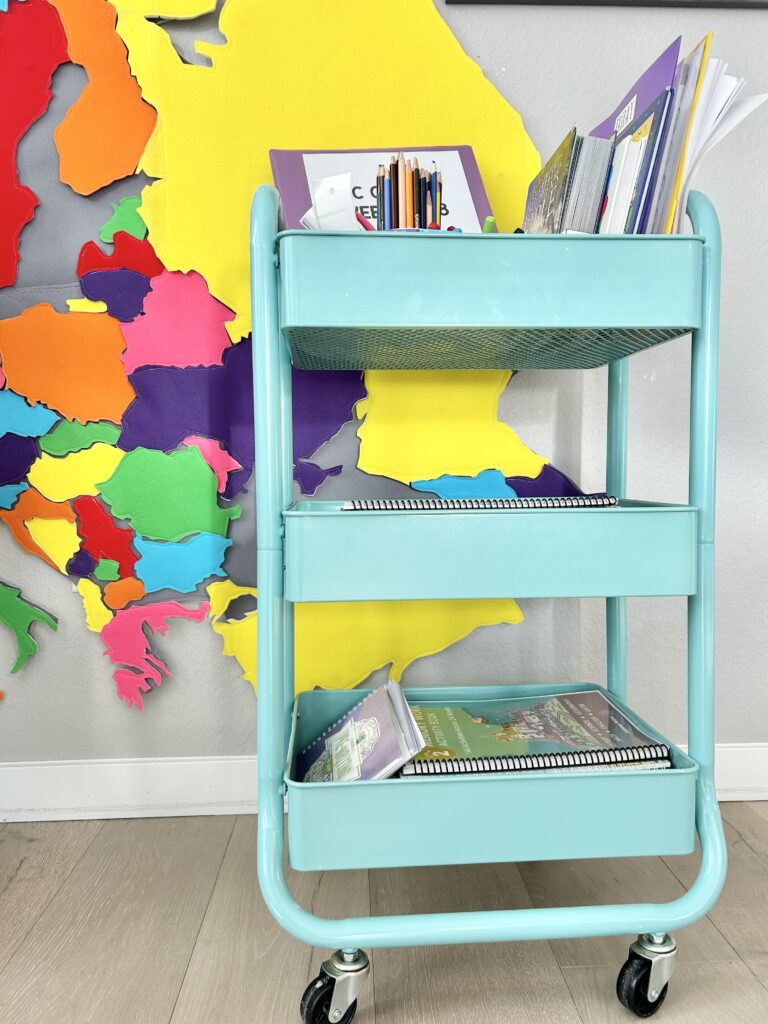
If you want to see more of the simple systems that keep our homeschool running smoothly, you can read more of my favorite organization ideas and hacks in my post here.
Waking Up Before the Kids
Another habit that has helped tremendously is waking up before the children. I do this most mornings because those quiet moments make such a difference in how the day unfolds. I usually work out first, then spend time praying and reading my Bible. Having breakfast and coffee alone sets my heart in a peaceful place before the noise of the day begins.
Of course, this is not always possible. There are sick nights, early risers, and unpredictable mornings. But when it works, it makes everything easier.
The Early Morning Moments With My Oldest
Around seven o’clock, my oldest daughter usually wakes up. I like to be reading my Bible when she comes downstairs because I want her to see that God’s Word is a daily priority for me. I have already had my quiet time earlier in the morning, but I purposely bring my Bible back out so she sees me in the Word as she begins her day.
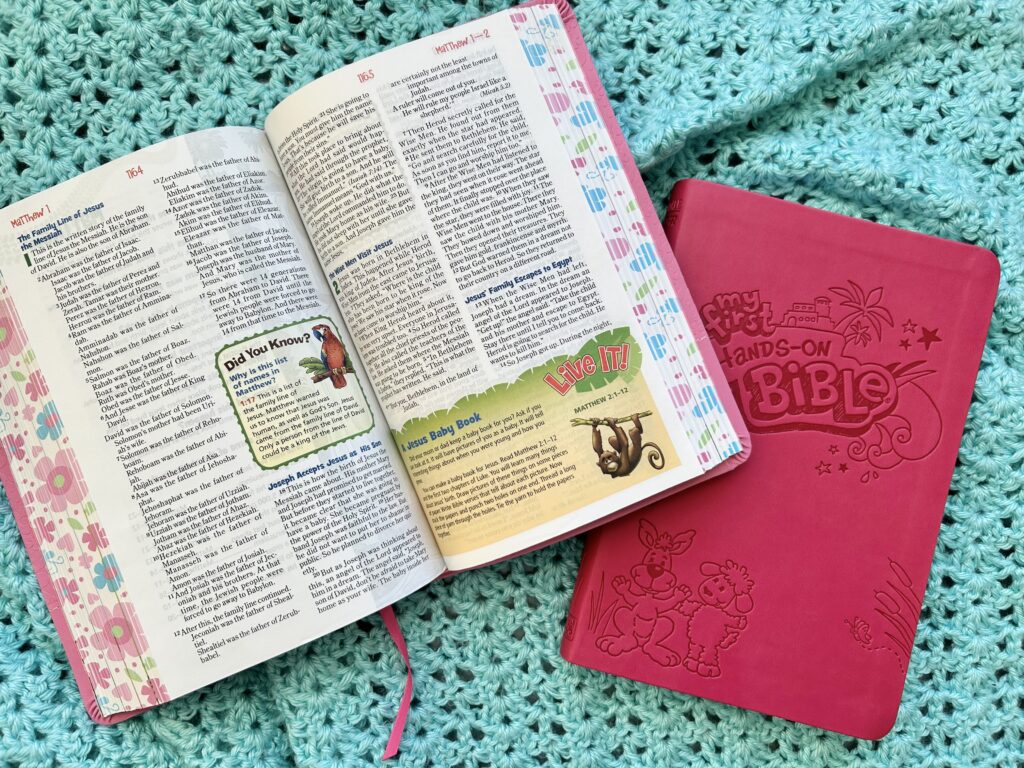
Once she curls up beside me, she reads from her children’s Bible or looks through another book while I finish the Proverb or passage I am reading.
After a few quiet moments together, we transition into her math lesson and gently ease into the school portion of our morning. I usually cook her an egg or two at this point so she has some protein to start the day, and we save our main breakfast for later when my two year old wakes up.
Math and Language Arts
We use The Good and the Beautiful for both math and language arts, and it has been a wonderful fit for our family. Each math lesson begins with a short portion that I teach, followed by a section my daughter can complete independently. If my four year old is awake during this time, she sits nearby with a coloring page while I help her older sister.

Math is one of my top priorities, and it is the subject where my daughter needs the most quiet to stay focused. Beginning our day with math has worked beautifully because her mind is fresh, the house is calm, and we can give the subject the attention it deserves.

We try to do as much of her math and language arts as possible before the younger two are up. Even ten minutes of focused work makes the rest of the morning flow more smoothly. After breakfast and Bible time, we simply finish whatever we were not able to get to earlier.

Read here why I decided to switch from Saxon math to The Good and The Beautiful (TGATB).
Breakfast and Bible Time
Around seven thirty or eight, my two year old wakes up, and my four year old if she has not already come downstairs. When the toddler is awake, we head upstairs to brush teeth and finish getting ready for the day before coming back down for breakfast.
During breakfast, I read the Bible aloud to the girls. We recently switched from The Complete Illustrated Children’s Bible to The Child’s Story Bible, which tells the stories in a warm narrative style while staying very faithful to Scripture. We are reading through Genesis right now, and the girls listen while they eat. When they finish, they draw what they heard on their personal whiteboards.

We also love reading a story or two from My ABC Bible Verses: Hiding God’s Word in Little Hearts by Susan Hunt, which gives us a natural way to talk about kindness, obedience, and character throughout the day. And of course, we always end by singing a hymn or two from My First Hymnal by Karyn Henley—one of our favorite parts of the morning. This time around the table is the anchor of our homeschool day. Even if nothing else goes exactly as planned, beginning with Scripture, prayer, and connection always makes the day feel meaningful.
The 24 Family Ways
We are also slowly working through The 24 Family Ways by Sally and Clay Clarkson. This week we learned our eighteenth Family Way and began memorizing the corresponding Scripture, Galatians 6:22-23.
I write both the Family Way and the Bible verse on small chalkboards that hang near our kitchen table so we see them throughout the day. Having the words visible helps us talk about them naturally as situations arise.
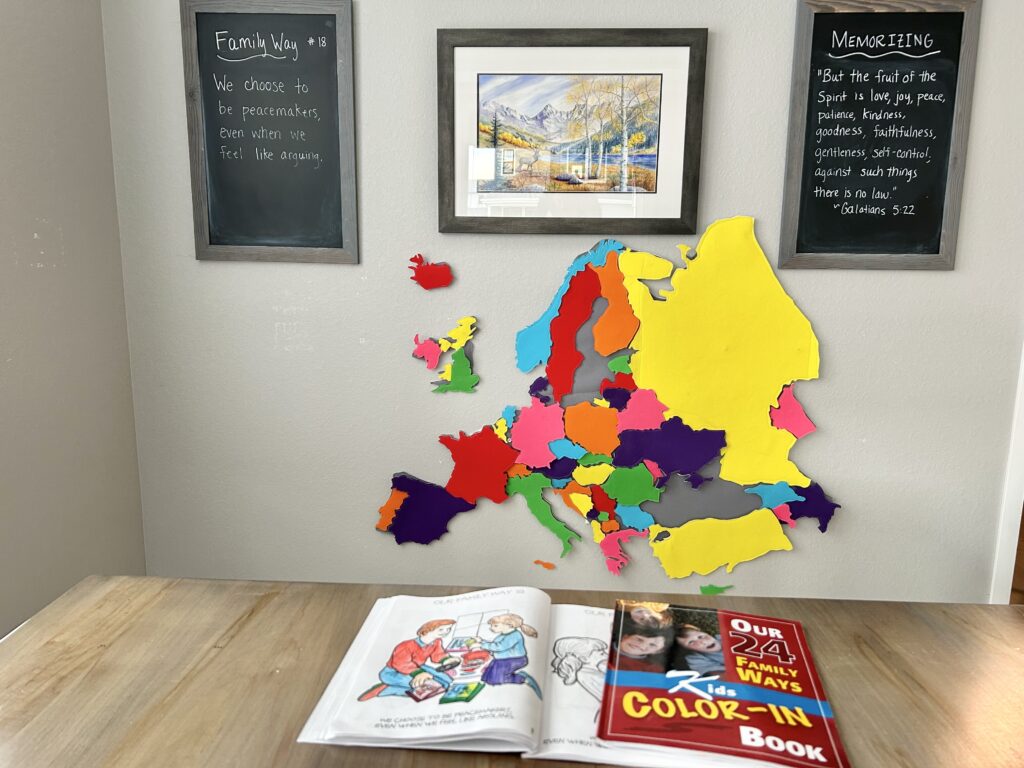
While I read the Family Way aloud, my girls colored the matching page from their 24 Family Ways coloring books. It gives their hands something to do while they listen and helps the lesson sink in gently.
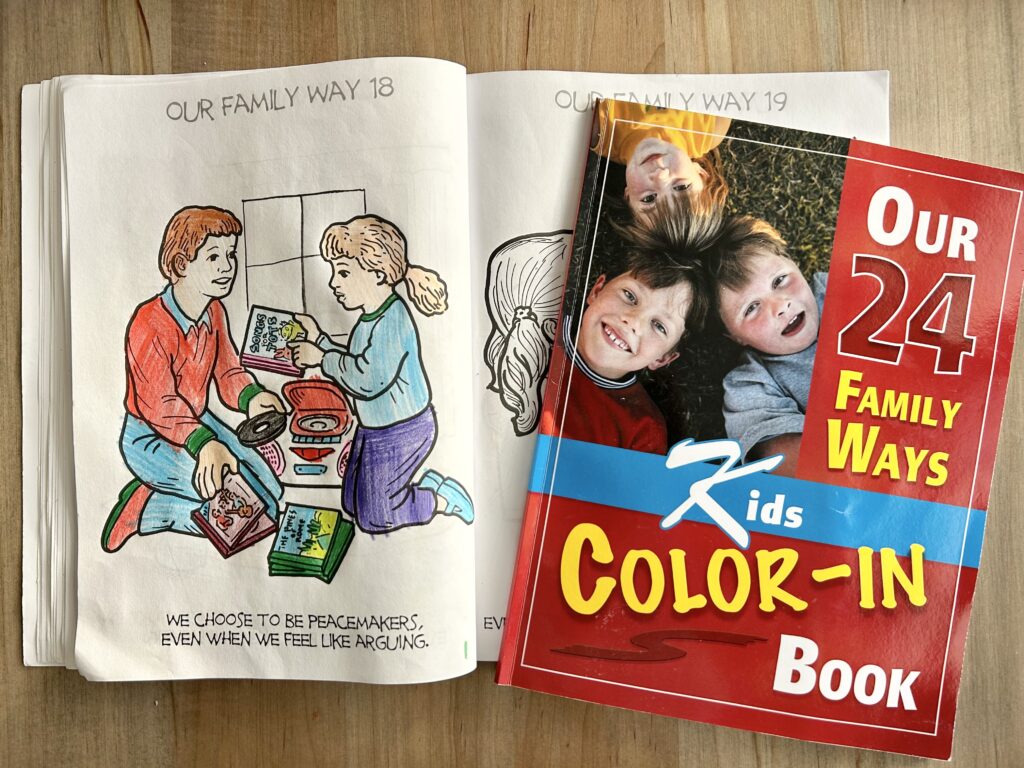
After reading, I play a song that is set to the Bible verse itself. I have found music to match each Family Way and its corresponding Scripture, and we return to those songs often throughout the week. Many of the ones we use are from Steve Green. Music has been one of the most powerful tools for helping my children hide God’s Word in their hearts in a joyful and lasting way.
If you would like access to the list of songs we use to match each Family Way and Bible verse, you can download my guide here.
Math, Language Arts, Handwriting, and a Toddler
After Bible time which is usually around 9:00 a.m., we finish any math or language arts we did not complete earlier. Both girls also do one handwriting page each day. During this part of our morning, my toddler plays with a rotating toy bin, which keeps him engaged long enough for me to focus on the older two and wrap up their lessons.
This simple rhythm helps us stay consistent with our core subjects, and beginning the day while everyone is fresh makes a noticeable difference. It keeps our mornings calm and productive without feeling rushed.
Preschool with my 4-year old
With my 4-year-old, I am keeping things very simple. She is now working through The Good and The Beautiful Kindergarten Prep Curriculum along with their pre-writing books, and that combination has been perfect for her.

I don’t believe children at this age need to be doing formal bookwork yet. I think play, stories, and being part of family life are the most important. But I like having these gentle resources because she often wants to do what her older sister is doing. Having her own activities gives her a sense of ownership and keeps her engaged.
We even call this her “math,” and she beams with pride when she sits down with her workbook. It is such a sweet way for her to join in without adding pressure, and it gives us a fun rhythm we can enjoy together.
A Short Break and Then Into Memory Work
Before we begin our memory work, we often take a short break. The girls might play outside for twenty minutes, run around in the basement, or we might take a quick walk together. This gives everyone a chance to reset and also gives me a moment to tidy up breakfast if I need to. These small built in pauses help the rest of our morning feel peaceful and manageable.
After that short break, we transition into our memory work at about 10:00am. Each week, I make a playlist of songs for all of the subjects we are learning: geography, history, science, Latin, English, and math. Some of the songs are ones I make up to help the girls remember their memory work, and others come from Classical Conversations. I play this playlist at some point in the morning or even in the car so the memory work becomes something they hear naturally throughout the day. See my playlist of Cycle 2 Week 18 songs for English, Science, Math and Geography below.
Daily Subject Focus
Even though we listen to all the subjects regularly, we always choose one subject to dive a little deeper into each day. Mondays are geography days. Wednesdays are history days. Thursdays are science days. Fridays are for math, Latin, and English memory work. Having a subject focus takes away decision fatigue for me and gives the kids a clear rhythm to follow. They know exactly what to expect, and it gives us space to linger a bit longer on each topic in a way that feels relaxed and enjoyable.
Here is our usual weekly schedule (you can download this template here):

What Geography Looks Like (Monday)
Mondays are our geography focus day, and this is one of the most enjoyable parts of our weekly rhythm. I set out our Classical Conversations geography placemats first thing. These give the girls clear visuals for that week’s new locations.
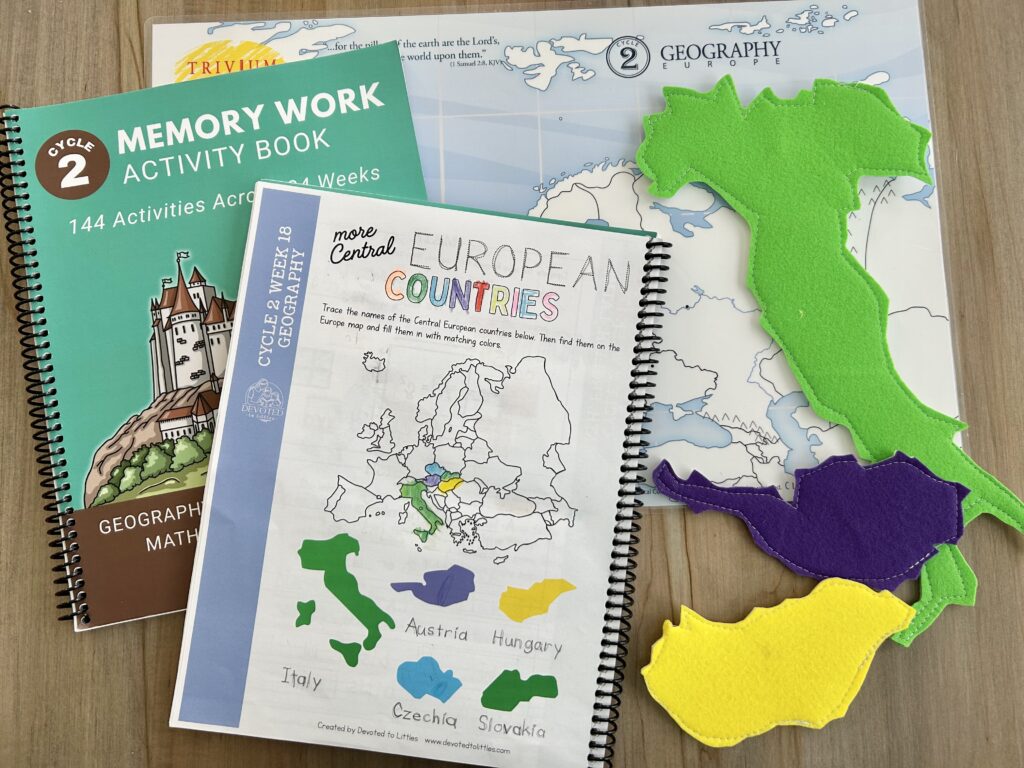
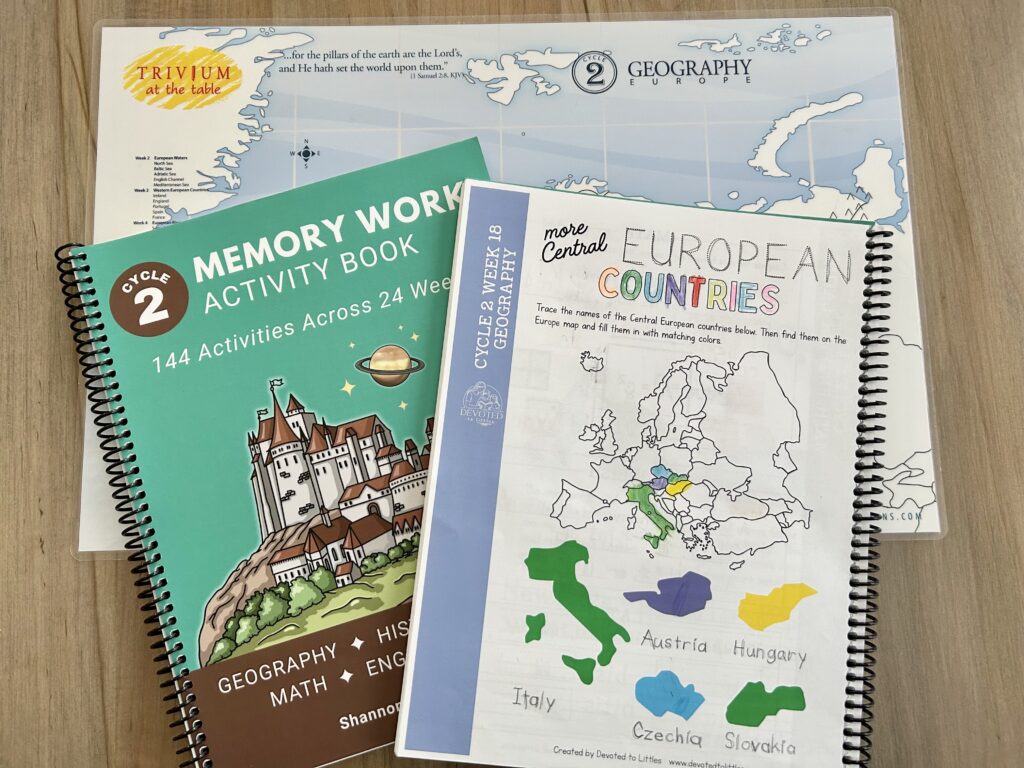
Then we open their Cycle Two Memory Work Activity Books. The geography activity for Week 18 introduces the new locations in a simple, child friendly way. The girls complete this page while we talk through the features, find them on the placemat, and listen to the geography song for the week. This week we learned about more central European countries: Italy, Austria, Hungary, Czechia, and Slovakia.
Diving Deeper into Europe!
Next, we use our European Countries Workbooks, which have been especially helpful this year since Cycle 2 focuses so much on European geography.
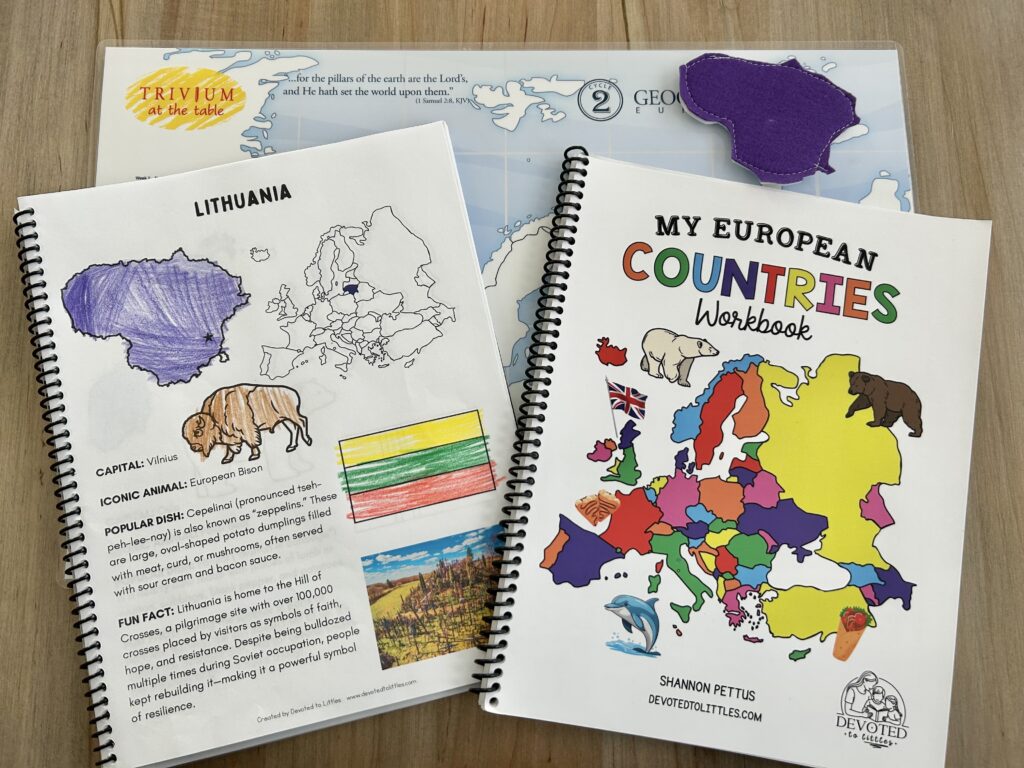
Each week we learn about a few new countries, read a short overview, and then find them on our large Europe wall map. We talk about something interesting or memorable about each location, which helps the girls connect the dots and remember what they are learning.

Pulling the felt countries off and placing them back on together continues to be one of their favorite geography activities and makes the map feel so interactive and hands-on. A few times a week, I take all of the felt countries we’ve learned so far off the map, and my girls work on putting them back in the correct spots. It’s so fun and they are getting very familiar with the European countries! Download paper maps of Europe with all the countries labeled here!
I have the patterns for all the European countries, as well as a tutorial about how to make this kind of map in my shop. Also see my video for how to make this map with a few simple materials. You can find more information and links for these materials here.
We also made up a fun song to help us learn all of these European countries!
Geography Passports
When they finish their activity and feel confident with the memory work, they stamp their Cycle 2 geography passports.

Every week we also take a few minutes to review the geography from the first half of the year as my oldest prepares to work toward Geography Master. Using her passport has been a great way to reinforce what she knows, and she loves adding stamps as we learn new geography each week. I recently figured out how to fit the stamps onto sticky circular labels, which makes stamping even easier and more fun!
To help with memorization, we also learned a new geography song for this week’s countries to the tune of Buffalo Gals. Singing the countries together always brings so much joy to our lessons and really helps the information stick.
If we have time, my oldest sometimes works through the Draw Europe resource, which helps her draw the outlines of countries step by step. We do not do this every week, but it adds wonderful reinforcement when time allows.

All together, geography takes around thirty minutes. It feels gentle, steady, and very doable.
What History Looks Like (Wednesday)
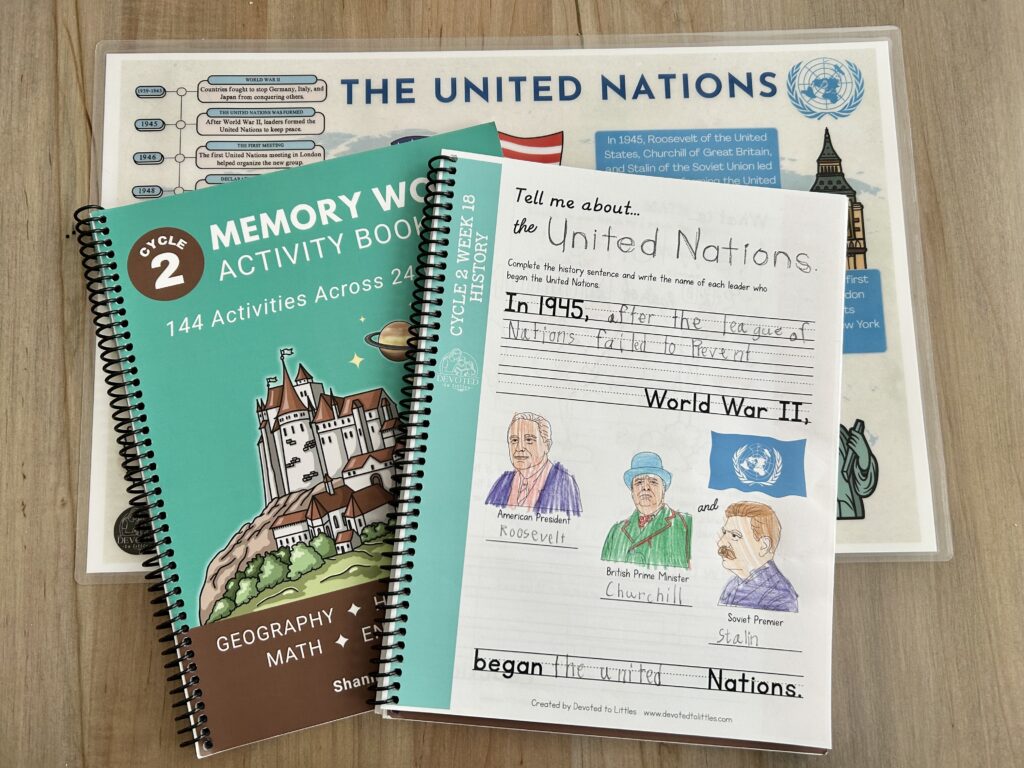
On Wednesdays we turn our attention to history. I put out our history placemats for Week 18 to give the girls a clear overview of that week’s topic.
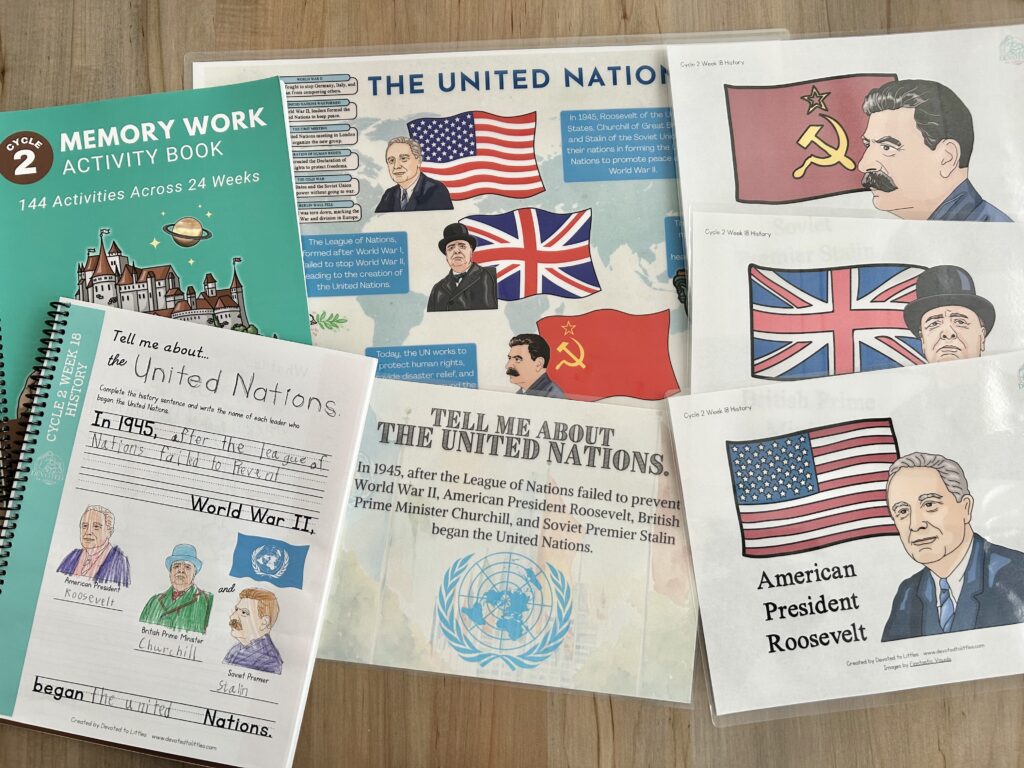
Then they open their history page in the Cycle Two Memory Work Activity Books. This introduces the memory work and gives them a short activity to complete before we listen to the accompanying history song. This week we learned about the United Nations and my daughters enjoyed coloring the leaders and wrote in the missing parts of the history sentence as we listened to the Classical Conversations song.
If I can find picture books that relate to the Week 18 topic, I read at least one while they finish their activity. This week we enjoyed reading Mercedes and the Chocolate Pilot by Margot Theis Raven. Be sure to check it out my Cycle 2 booklist! I’ve gathered picture books that connect to every week of the memory work this cycle!
When it fits with the subject, I sometimes read from The Story of the World. I do not do this every week, but for certain topics it adds context and helps them connect the pieces.
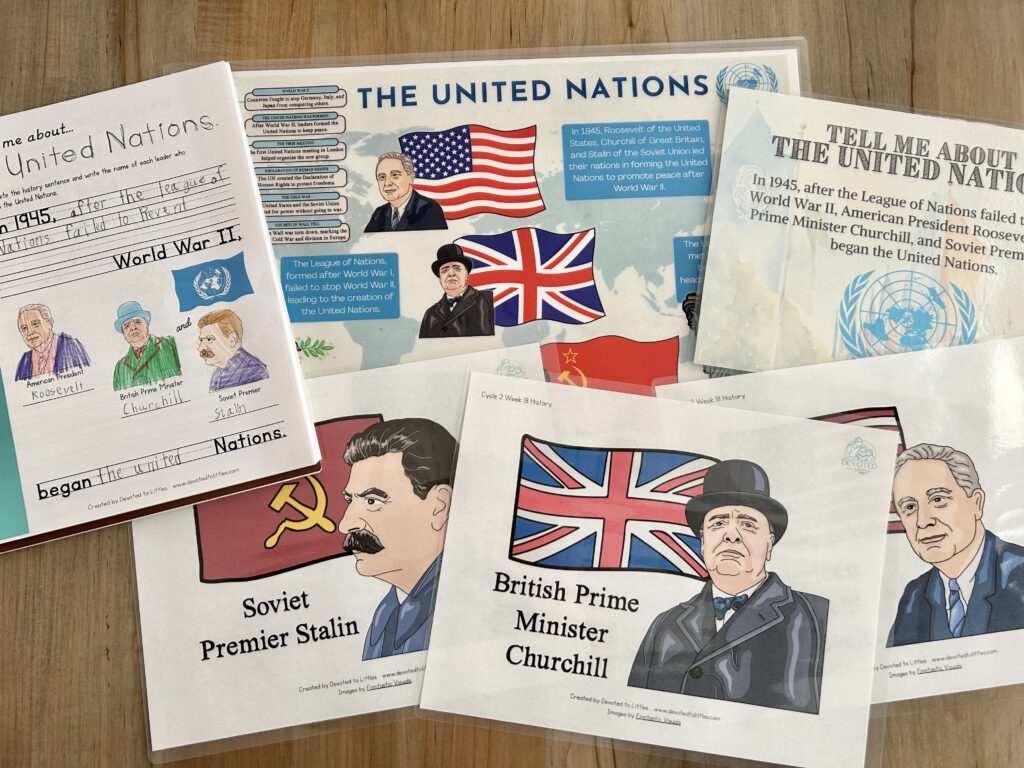
This week I also pulled out signs of each of the leaders involved in the United Nations. I made this to use as a tutor in our community group and they were a great visual to use at home too! Grab these signs to use in your class too HERE! I also love the beautiful water color memory work cards that Kimberly Vieley makes for each subject.
All together, just like geography, history takes around thirty minutes. It feels gentle, steady, and very doable.
NEW Cycle 2 History and Science Placemats
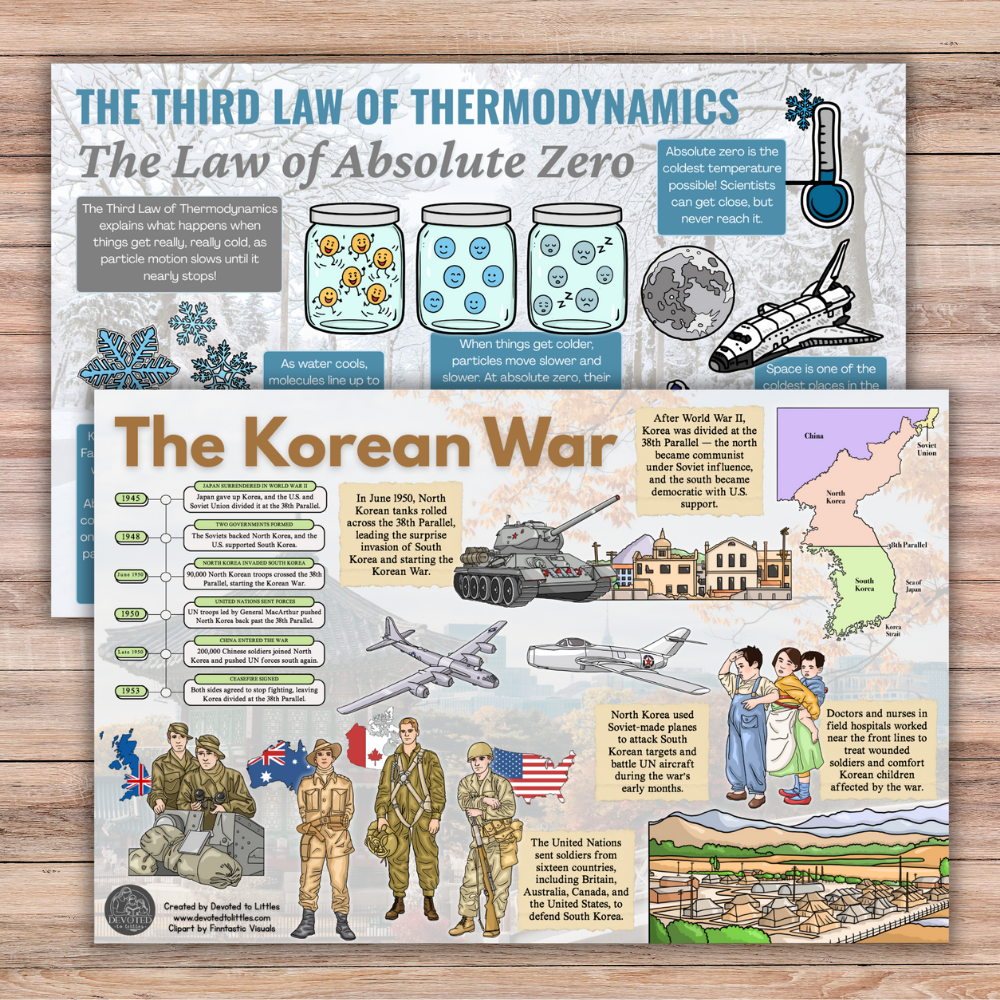
These brand-new Cycle 2 History and Science Placemats are designed to make memory work fun and interactive for kids, whether you’re using them alongside Classical Conversations or on their own as a way to dive deeper into history and science.
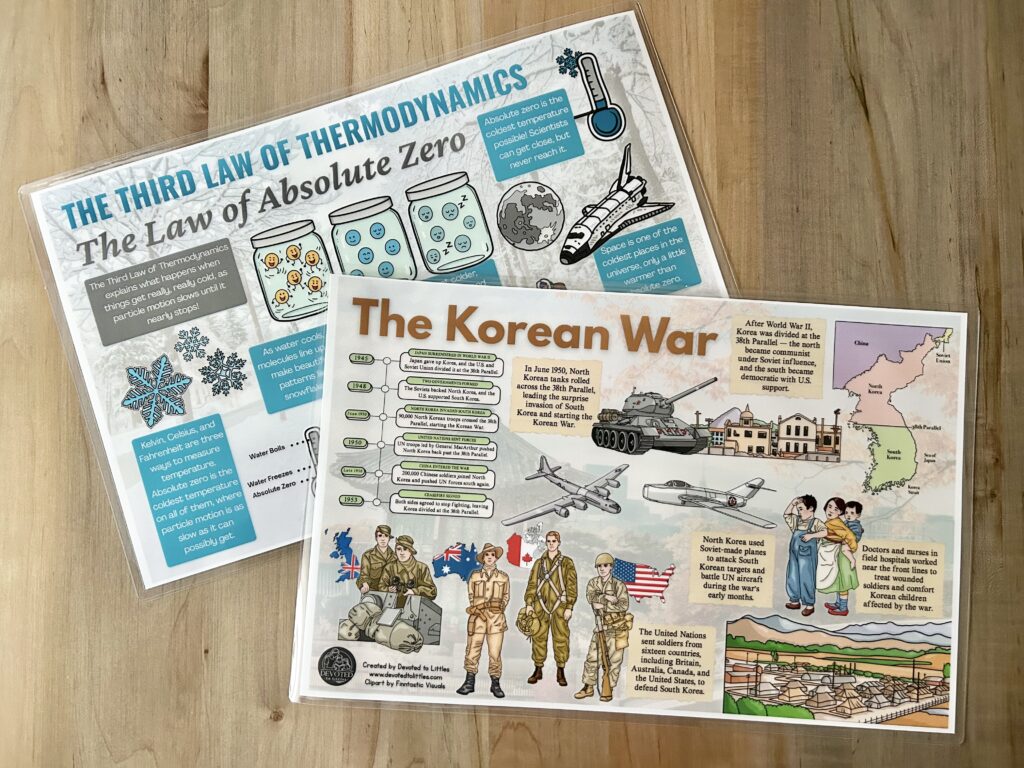
Each placemat is filled with colorful visuals and simple explanations that bring the topics to life. Just print, laminate, and use them again and again during meals and review time. They’re an easy, no-prep way to dive deeper into the history and science topics with your kids. Get your set for Weeks 19-24 below. The other three quarters are also available HERE!
What Science Looks Like (Thursday)
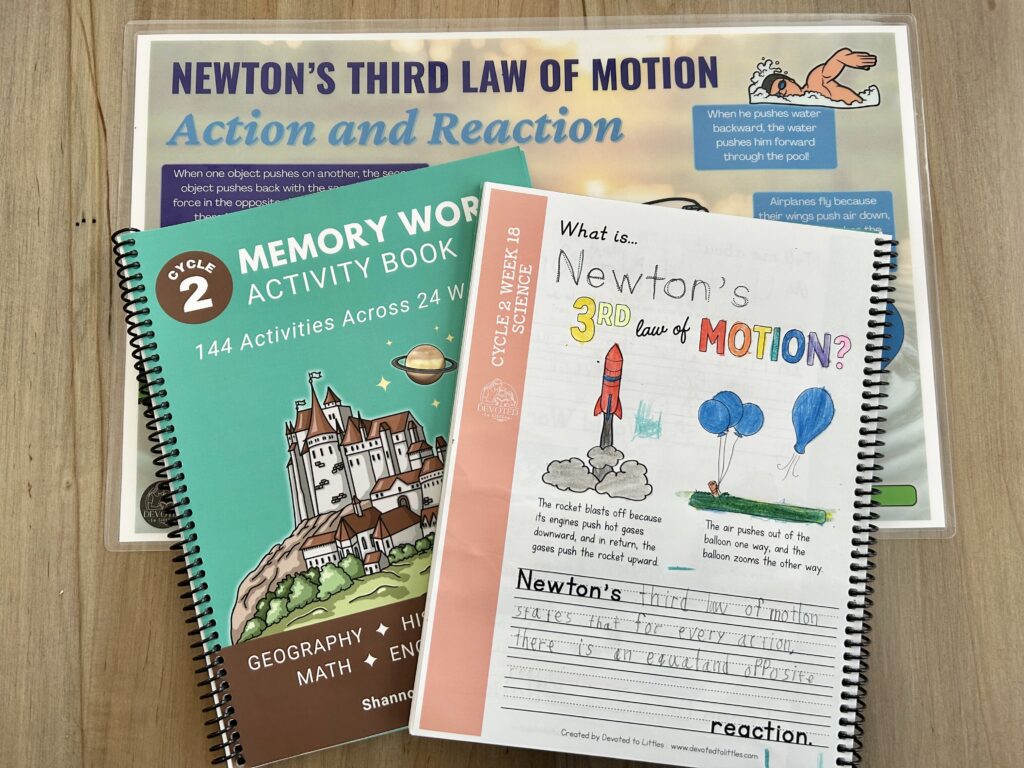
Thursdays are for science. I set out our Science Placemats for Week 18 and we begin by reviewing the visual chart and the key ideas for the week’s topic.
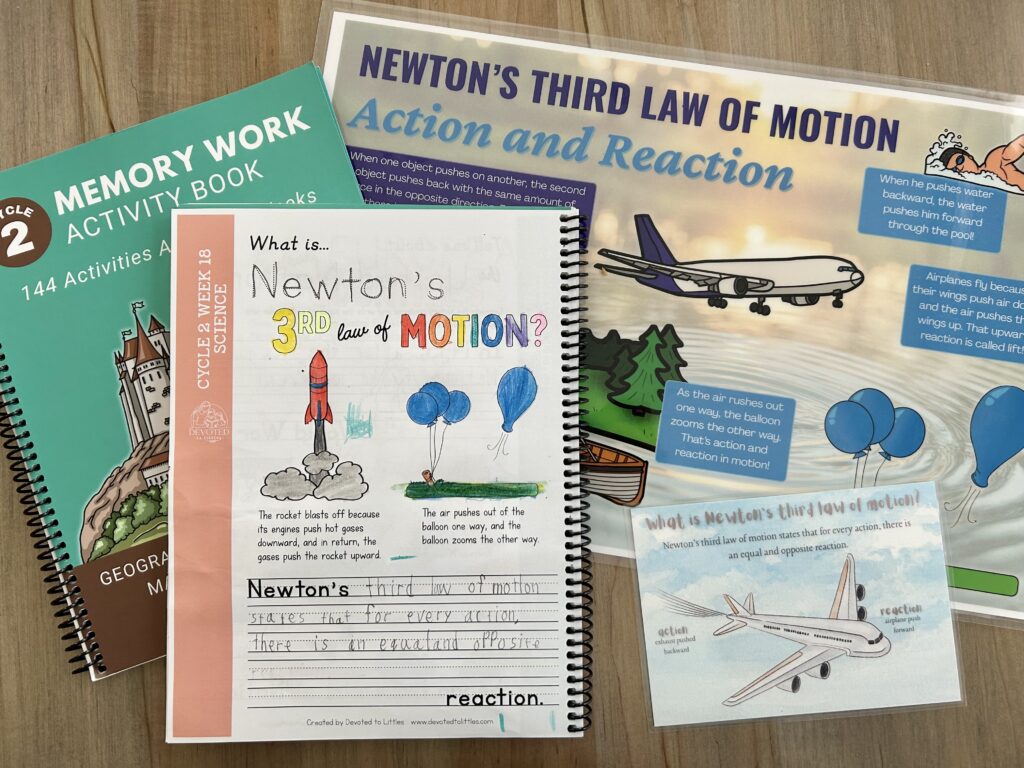
After this, the girls open the science page in the Cycle 2 Memory Work Activity Books. We talk through the memory work, complete the activity, and connect the ideas to the placemat.
If I have found picture books related to the Week 18 science concept, we read a few while the girls eat a snack or color. Some weeks we include a small hands on activity, but only if it is simple and adds real value. Right now, reading aloud is still my main priority.
Newton’s Law of Motion Dominoes Game
We did play this fun Newton’s Law of Motion Dominoes game I made again this week, which helped us see different examples of Newton’s three laws of motion. You can grab this game, as well as a fun Latin Bingo and Shapes game from my resource library below!
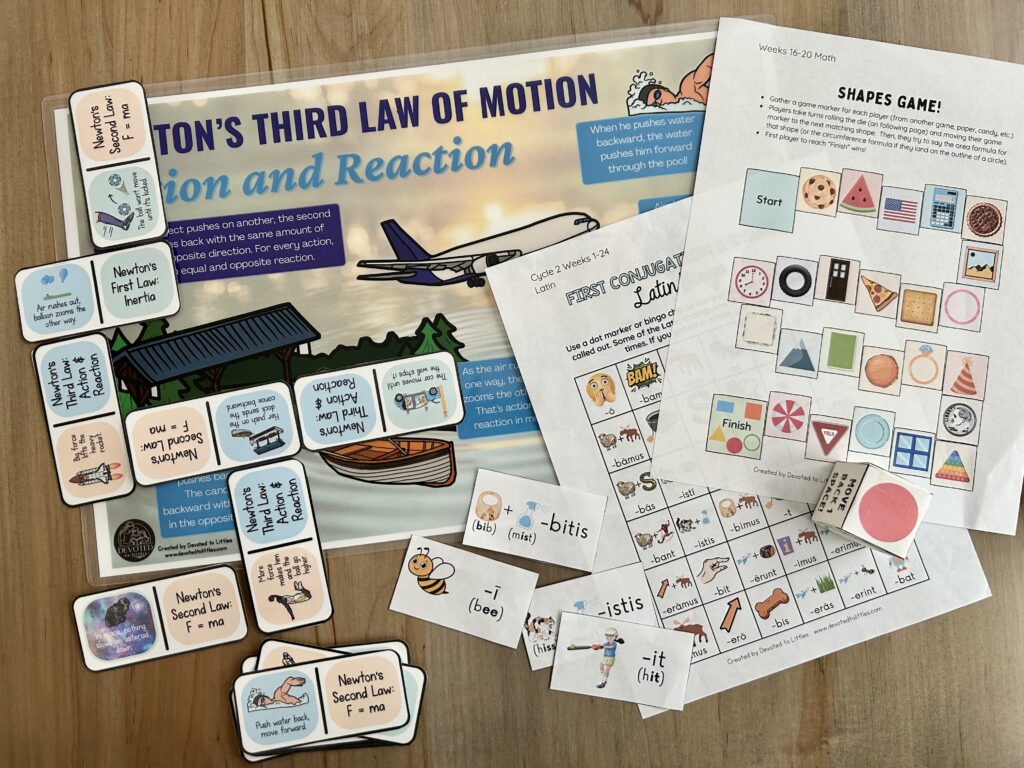
Also, to help my girls remember the new vocabulary, we sang a fun song to the tune of Baby Bumblebee. Songs are such a simple, joyful way to reinforce what we learned while keeping science time lively and fun!
Fridays for English, Latin, and Math Memory Work
Fridays are the simplest. We work through the English, Latin, and math memory work for the week and complete the Cycle 2 Memory Work Activity Books pages for Week 18.

Then we sing the memory work songs together. This week we enjoyed singing our Five Cases of Nouns song to the tune Ring Around the Rosie. If I happen to have a picture book that connects to the material, we read it, but many Fridays we simply do the activities and the songs.
The memory work activities kept things engaging and gave my 6-year-old and 4-year-old extra practice with writing and tracing. Having dedicated time at the end of the week to pull these subjects together worked really well for us, and it gave a sense of closure before heading into the weekend.
Picture Books for Cycle 2 Week 18
Here are all the picture books we enjoy this week:
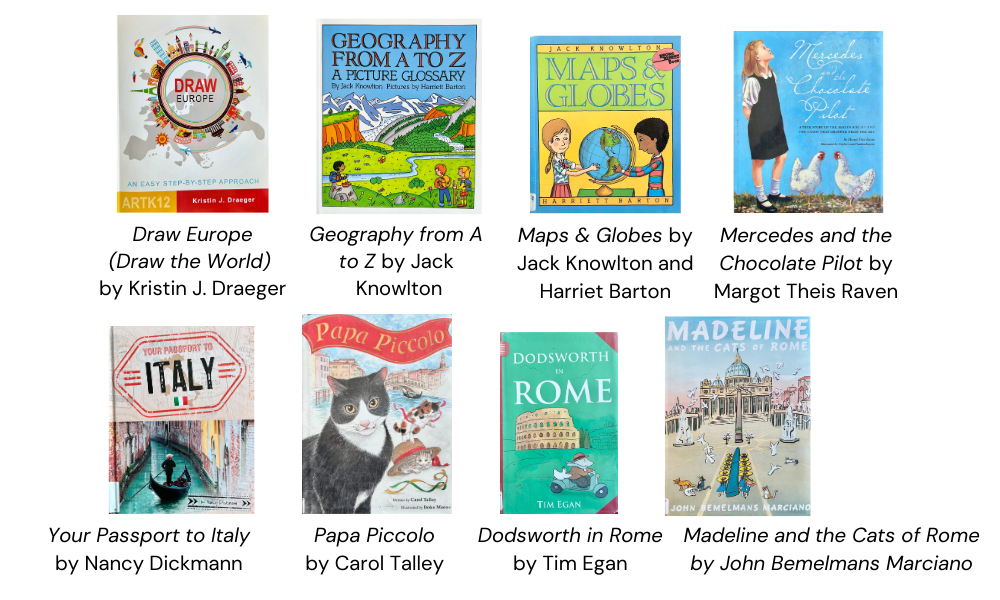
- Geography from A to Z by Jack Knowlton
- Draw Europe (Draw the World) by Kristin J. Draeger
- Maps and Globes by Harriet Barton
- Mercedes and the Chocolate Pilot by Margot Theis Raven
- Your Passport to Italy by Nancy Dickmann
- Madeline and the Cats of Rome by John Bemelmans Marciano
- Papa Piccolo by Carol Talley
- Dodsworth in Rome by Tim Egan
You can see my ENTIRE Cycle 2 picture book list for each week of Cycle 2 here!
A Few Simple Review Games for This Week
Sometimes we add a simple review game to keep memory work fresh and fun. This week I created a science game, a Latin endings BINGO game, and a geometry review game that match Cycle 2 Week 18.

These are not required to have a successful homeschool week. They are simply tools that make review feel joyful instead of repetitive.
If you would like to use them with your children, you can sign up below to receive the free downloads.
Afternoons: Reading, Rest, and One on One Time
After our focused subject work, we take a longer break. The children might play outside, take a walk, or have a play date if we have one planned.
During lunch, I read a chapter book. We are working through The Trumpet of the Swan, and this lunchtime reading rhythm has become a sweet and effortless way to build more literature into our day.
Quiet time begins around one o clock. My toddler naps, and I use that window to spend intentional one on one time with each of my older girls. Even though we homeschool and are together most of the day, meaningful connection does not just happen automatically. I have learned that I need to make space for it. If you would like to read more about simple habits like this that are quietly transforming our days, you can find that post here.
Evenings and Family Reading Time
After dinner, my husband plays with the children while I finish up in the kitchen. Then we gather for family reading time. We start with a picture book for the toddler, followed by a chapter from Little Pilgrim’s Progress, and finish with a passage from the Bible and prayer.
This closes the day with calm, connection and truth.
So Are You Doing Enough
When you look at our routine written out, you can see it is not overloaded or complicated. It is steady, intentional, simple, and built around the things that matter most: Scripture, reading, connection, and a clear plan for learning.
Some days we accomplish more. Some days we accomplish less. But the foundation stays the same.
If you are showing up for your children, reading to them, teaching them little by little, and building a home that values faith, relationship, and learning, you are doing enough.
More than enough.
If You Want Support Without Adding More to Your Plate
One thing I have learned over the years is that doing “enough” does not mean doing everything. It means choosing tools that support your season instead of overwhelm it.
If you are part of a Classical homeschooling community and you are tutoring, you know how quickly planning can become a heavy load. I have shared weekly tutor ideas for each week of Cycle Two on the blog, and I also record weekly tutor videos on my YouTube channel where I walk through memory work ideas and simple ways to make community day engaging without adding hours of prep.
For example, I recently shared tutor ideas for Cycle 2 Week 18, and you can find many other weeks there as well. My goal is always to make tutoring feel lighter, not heavier.
Fine Arts: Keeping It Sweet and Simple
Now that we are in the second half of Cycle 2, Fine Arts has shifted to Great Artists, and it has been such a sweet rhythm in our home. Each week we focus on one artist, look at a few well known works, talk about simple takeaways, and then create something inspired by that style.

It is not elaborate. It is not complicated. It is just steady exposure and conversation.
If you would like to see how we structure Great Artists time at home and in community, I share that here along with free week by week artist bios and printable artwork.
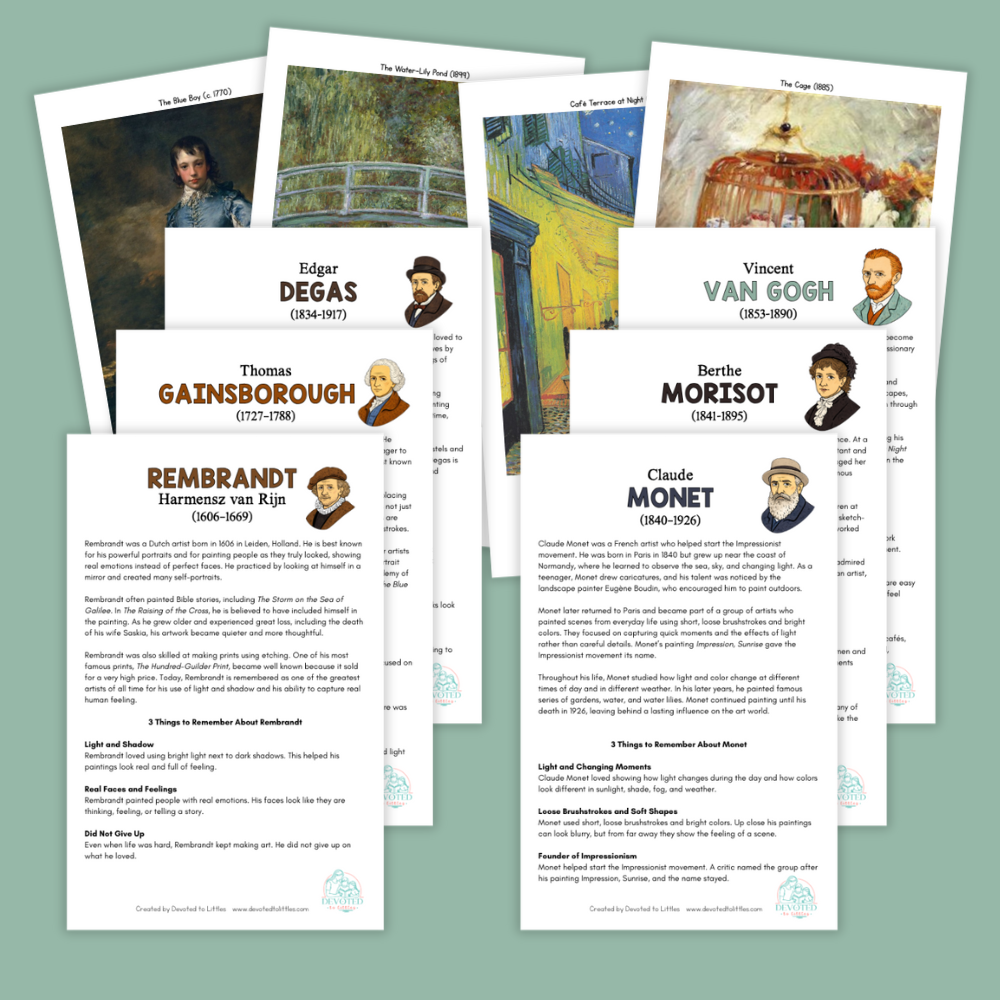
I also created a few low prep review tools like mini books and simple card games that make reviewing artists enjoyable without requiring extra planning from me.

Again, these are not things you have to add. They are simply tools that make our weeks smoother.
Review Does Not Have to Feel Boring
One of the biggest lessons I have learned is that review can either feel heavy or joyful depending on how it is structured.
I created a Cycle 2 Weeks 13-24 Review Activity Book to help my kids review, connect, and celebrate everything they’ve learned in the second half of Cycle 2. It gives us a simple, open and go way to review geography, history, science, math, Latin, English, and the timeline without me having to invent something new.

Inside, you’ll find 50 engaging activities that make review time interactive and joyful. Each page reinforces memory work while encouraging deeper connections and confidence. Whether you use it during a mid-cycle break, after you complete cycle 2, or as part of your regular review time, it’s an easy, low-prep way to keep learning fresh and fun.
You can find the Cycle 2 Weeks 13-24 Review Activity Book in my shop. I also have a Cycle 2 Weeks 1-12 Review Activity book that reviews the material from the first have of Cycle 2.
Fun Review Games for Cycle 2
We also use simple themed review games like Historyopoly and Memory Work Kingdom. These turn review into laughter and movement instead of worksheets and pressure. The goal is not to cram more in. The goal is to reinforce what we have already learned in a fun and natural way.
Cycle 2 Historyopoly
One of our favorite ways to review history is with Cycle 2 Historyopoly, a brand new game I created this year.

It is modeled after Monopoly but uses all of the Cycle 2 history sentences. The kids love rolling dice, moving around the board, and reviewing history facts as we play. It turns review into something exciting and fresh, and we will definitely be pulling it out again many more times this year. You can grab this NEW game here!
Memory Work Meadowland (Spring Edition)
We’ve also been playing Memory Work Meadowland, a Spring/Easter-themed review game (since Spring is coming soon!). It works just like Candyland, but with the addition of memory work review built in. Players move along the board by drawing cards with color blocks or picture spaces, then answer a review question that matches the space they land on. Correct answers let them stay put, but if they miss, they move back. The game also includes fun twists with water slides and ladders to keep things lively. The first player to reach the church wins!
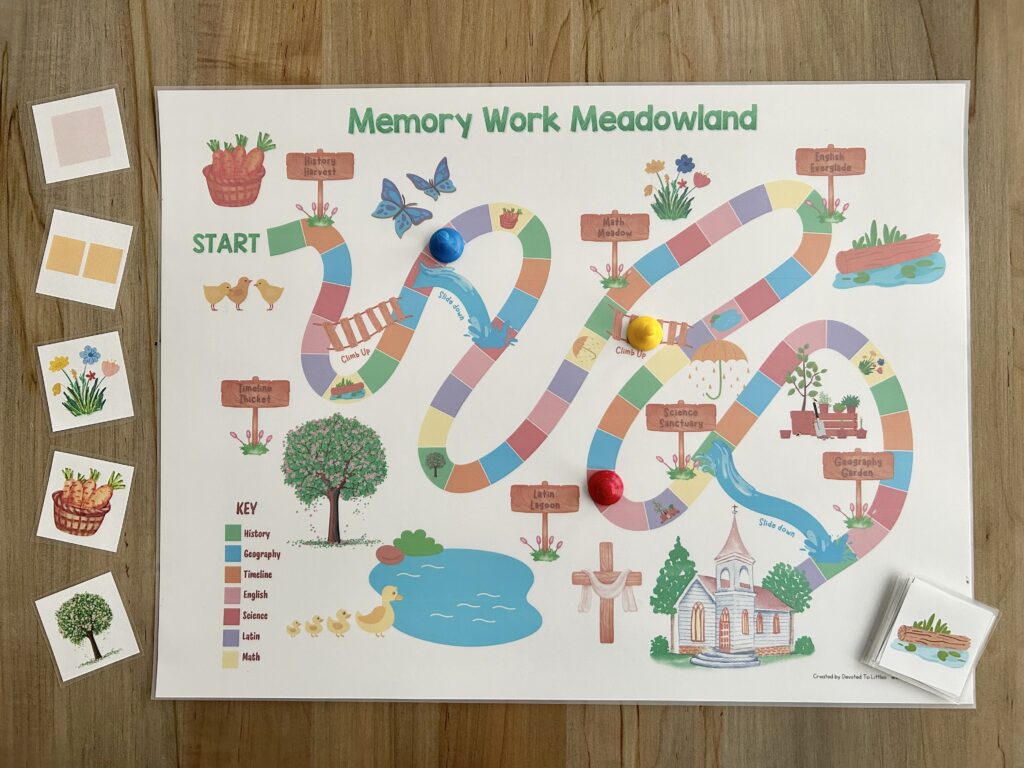
The best part is that I now have a fall version, a winter version, and a spring version, so you can rotate them throughout the school year. You can grab each one individually, or get the seasonal bundle with all three at a special price.
These games work for all three cycles and have been such a hit in our home. They are perfect for community review days, family game nights, or just a fun way to end your homeschool week. You can find them all in my shop!
Planning Our Homeschool Week
Instead of printing out detailed lesson plan templates this year, I have been using my homeschool planner to keep everything organized. It has been such a helpful tool for me as I think through our week.

I use the Cycle 2 memory work pages in the planner to map out how we will practice the memory work together. These pages make it easy to see each subject at a glance and jot down games, songs, or activities that I want to use with my kids. I also use the weekly and daily planning pages to schedule what we will do each day for math, language arts, and reading.

I’ve tried to simplify things this year so I don’t need to spend a lot of time prepping or printing. Having the Cycle 2 Memory Work Activity Book and my Cycle 2 Picture Book List ready to go means I can sit down and plan the week quickly without extra work.
Another part of the planner that I love is the monthly habit tracker. I use it to write down a few habits I want to focus on each month, like improving my health and being more present with my kids. It’s been a great reminder of the small but meaningful steps I want to take.

This planner has truly helped me stay organized so far this year, and it makes planning feel simple and purposeful instead of overwhelming. Get one for your homeschool year here!
A Final Word for the Mom Wondering If She Is Doing Enough
If you made it this far, I want to gently remind you of something.
You do not need a perfect routine.
You do not need every resource.
You do not need to replicate someone else’s homeschool.
What matters most is not how much you cover.
It is the atmosphere you are building.
If your home is filled with Scripture, conversation, stories, laughter, and steady faithfulness, that is enough.
If you are showing up, reading aloud, teaching little by little, and loving your children well, you are doing holy work.
Homeschooling is not about doing more.
It is about doing what matters most, consistently.
And that is exactly what you are doing.
If you would like more encouragement and simple ideas for Classical homeschooling, you can:
- Browse my Cycle 2 resources here
- Visit my YouTube channel for weekly memory work ideas
- Or join my email list for free games and encouragement
Wherever you are in your homeschool journey, I am cheering you on.