

Cycle 2 Week 7 Tutor Ideas for Classical Homeschooling
This week, I have lined up activities that balance fun and focus with lots of movement, creativity, and review to keep energy high while helping the memory work settle in naturally.

As always, I’m not affiliated with any Classical education organization—these are just my own ideas and practices from tutoring over the years. I hope these Cycle 2 Week 7 plans give you fresh inspiration and encouragement as you prepare for your own class or homeschool day.
We love being part of our Classical homeschooling community. Read more about how God redirected our path from private education to homeschooling and Classical education here.
This post contains affiliate links, which means I make a small commission at no extra cost to you. See my full disclosure here.
Are you new to the Classical model and want to know more about it? Keep reading below about how it’s organized, the different cycles, our community time, and MORE!
If you already know about the Classical homeschooling model and you are ready to jump to the actual tutor ideas, click HERE.
A Classical model of homeschooling
We are part of a Christ-centered homeschool program that follows the Classical model. The younger children, ages 4-12, focus on a memorization-based curriculum which acts as the groundwork of learning that is built upon in later years.
Children and their parents learn key facts across the core subject areas including history, science, English, mathematics, geography, and Latin. Tutors use fun activities, games, songs, and lots of energy to introduce the new material. The parents can then expand on that material at home throughout the week.
Cycle rotation
The material is divided into three cycles, which each last one year. The cycles continue to rotate every three years, so most children who start when they are kindergarten age, complete each cycle at least twice. This allows them to develop a deeper comprehension and grasp of the material through repetition.
Cycle 2 material
This year in Cycle 2, we’re learning about pre-Reformation to modern history, ecology, astronomy, and physics; Latin verb endings; English pronouns, adverbs, and conjunctions; skip counting, conversions, and more!
The following ideas are what I’m planning to do with the group of kids I am tutoring this year (ages 4-6). You may use these ideas if you are also tutoring in a Classical homeschooling community, or if you’re a parent who is looking for memory work ideas to use at home.
Also, you don’t have to be part of any particular Classical homeschooling group to use these ideas! These are ideas to help children learn key concepts in the core subject areas. If you are a homeschooling parent, or just a parent who wants to supplement what your kids are currently learning in school, these ideas will be helpful for you.
Community group time
Our homeschooling community has been meeting on Tuesdays. Our leader starts off the morning with everyone together in a big group setting. She typically begins that time with a devotional reading and prayer, and then continues with some announcements, celebrating birthdays, the pledge of allegiance, and anything else she wants to cover with everyone.
After this time, we split off into our different groups based on age. The tutors lead their groups into different classrooms and begin the New Grammar part of the day. This is when the tutor introduces the memory work for each core subject. Check out my post and video about how to make your own tutor board!

Cycle 2 Week 7 Tutor and Memory Work Ideas
New Grammar
Geography – European Peninsulas
This week in geography we are learning about the European Peninsulas: Iberian, Balkan, Scandinavian, and Apennine.
Before introducing the new material, we’ll take a few minutes to review the mountains we learned last week. Then we’ll set off on a new adventure—this time traveling to some peninsulas! I’ll have the peninsulas outlined on these trivium table maps in different color dry erase markers so they stand out clearly.

To make it extra fun, I’ll give each child a little shark keychain or fish figurine. Their shark will “swim” from peninsula to peninsula as we learn together.
Then, we’ll travel together, making up a silly rhyming story along the way:
- In the Iberian Peninsula, our shark reads with a librarian.
- In the Balkan Peninsula, our shark soars with a falcon.
- In the Apennine Peninsula, our shark stops to dine.
- In the Scandinavian Peninsula, our shark peeks inside a cave.
Then, I’ll teach them a fun review song to the tune of The Muffin Man, using all four peninsulas. We’ll sing it several times while pointing with our sharks to each peninsula on the map. See my video below.
To finish, I’ll quiz them with questions like:
- Which peninsula had a shark reading with a librarian?”
- Where did the shark sore with a falcon?
- Who remembers where the shark stopped to dine?
I also like to show them what a peninsula is using the book, Geography from A to Z by Jack Knowlton. This mix of mapwork, silly rhymes, and singing will give the kids plenty of repetition and laughter, making geography both memorable and fun!
English – Possessive Pronouns
This week we are continuing with pronouns, moving into possessive pronoun adjectives. We’ll keep using the same song to the tune of Here We Go Looby Loo, so the children can keep stringing all the pronouns together from Week 4 through Week 13 in one fun, continuous song.
To begin, I’ll introduce just this week’s possessive pronoun adjectives: my, your, his, her, its, our, your, their. I’ll sing them with the tune first, then invite the kids to join me. This time we will change up our motions—shaking the left foot while we sing the first few words, and the right foot for the rest. The movement gives their bodies something to do while their minds focus on the words, which makes memorization easier.
Once we’ve practiced this new set, we’ll sing from the very beginning, adding in the nominative, objective, and possessive pronouns from the past three weeks. By the end, the kids will be singing all four groups together, building a strong foundation for the weeks ahead!
Here’s the video if you’d like to use the same song and motions:
After practicing together, we’ll sing it a few more times in different ways: quiet voices, loud voices, whisper, etc.
Timeline
The timeline stays the same each cycle, and this week we continue with the next seven cards.
I often use these Timeline Cards in class: Set 1 (Ancient World), Set 2 (Medieval World), Set 3 (New World), and Set 4 (Modern World) I highly recommend investing in them (you should get all four sets) whether you are a tutor or a parent. I consistently use them as a tutor and also at home with my kids.

Since I have the 4-6 year old children, I like to tape the paper letter that the timeline event starts with at the top of the card. I have found these letters at my local Dollar Tree. Some of the children in my class can’t read yet, so this helps them identify the event I’m referring to.

Cycle 2 Week 7 Timeline
Before our class time begins, I put seven pieces of painters tape on the wall where the timeline cards will go, then I hide the cards around the room. I try to choose hiding spots that aren’t too tricky but still make the game fun.
When it’s time to start Timeline, I tell the children to find one or two cards (depending on how many kids I have) and bring them back to their seats. As they search, I sing this week’s part of the timeline song (instead of playing it), so I can set the pace and keep them focused. See my tutor video for the tune of this week’s timeline song.
Once all the cards are found, we’ll work together to put them in the correct order on the wall. For example, I might say:
- “The first card is Jesus the Messiah. What letter does ‘Jesus’ start with?”
- A child answers: “J.”
- I’ll respond: “That’s right! Who has a card that starts with J?”
Whoever has the card will bring it up and tape it in the first spot. We’ll repeat this for each timeline event until all seven are displayed.
Now it’s time for the surprise twist! I’ll explain that some of the cards might have a “bomb” on the back. Each child will take turns picking a card to flip over.
- If it’s not a bomb, we celebrate and do the hand motion for that event.
- If it is a bomb, I’ll exclaim, “Oh no, it’s a bomb! Take cover!” and the children will drop to the floor and cover their heads. Then we’ll flip the card back, tape it up, and do the hand motion for that event.
We’ll keep going until all three “bombs” have been revealed. To finish, we’ll sing through the whole timeline section once more with hand motions. If the group has energy to spare, I might have everyone do a few silly push-ups or a quick wiggle break before moving on.
See my video below which includes the hand motions for this week’s timeline section:
Math
This week we’ll focus on the 13’s, and I’m adding a fun twist to keep the kids engaged!
I’ll start by singing the 13’s skip counting song once while pointing to the numbers on my tutor board (see my tutor video for the tune). Then we’ll play a game together using action cards and the numbers on the board.
Here’s how it works:
- I’ll invite a volunteer to come pick an action card (for example: jumping jacks, spinning, or clapping).
- That child will also choose one number for me to circle on the board.
- We’ll sing through the 13’s song, and whenever we reach the circled number, everyone will do the action!
Next, another child will get a turn. This time, they’ll pick a new action card and choose two numbers for me to circle. Now we’ll have three circled numbers on the board, and each one has an action tied to it. We’ll sing the song again, adding the new actions as we go.
We’ll keep repeating this process, letting each child choose a new action card and circle even more numbers. By the end, every number on the board will be circled, and we’ll be doing an action for each number in the 13’s while singing the song.
This activity gets sillier and more energetic as it builds, giving the children lots of repetition with their 13’s while keeping them fully engaged and moving.
You can download these fun action cards for free below!
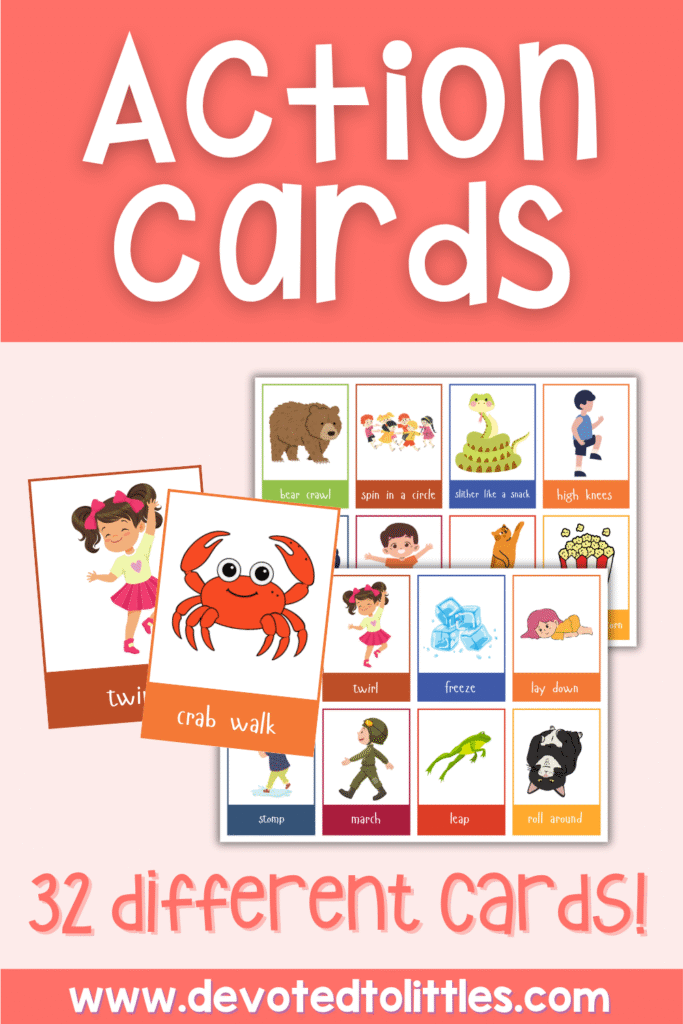
You can download my UPDATED printable Silly Voice and Action Cards for free by entering your email in the form below and I’ll send them straight to your mailbox!
Silly Voice and Action Cards
History
This week our history sentence is: In 1517, Martin Luther began the Protestant Reformation by printing the Ninety-five Theses that made Pope Leo X excommunicate him. Later, John Calvin joined the Reformation.
To help the kids learn this sentence in a fun way, we’ll play the “Silly Words” game again.
First, I’ll sing the history sentence correctly and ask the children to listen carefully (see my tutor video for this week’s tune). Then, I’ll sing it again but sneak in silly words. For example:
In 1517 Martin Burger began the Protestant Refrigerator by printing the Ninety-Five Pizzas that made Pope Lego X excommunicate him. Later John Cabbage joined the Dance Party.
Whenever they hear something silly, the kids raise their hand and tell me the correct word. Each time they correct me, I go back and repeat the sentence correctly from the beginning until I get to the next silly word. This way the children hear the correct sentence many times while laughing and staying engaged.


Then I hand out these cute miniature guitars to each of the children and encourage them to strum their guitars as we sing the history song a few more times.
Science
This week in science, we’re learning about the six forms of pollution: noise, air, water, thermal, radioactive, and land.
We’ll sing a simple song to the tune of Jack and Jill to help us remember them. See my video below:
To make it even more fun, I’ll teach the kids motions for each type of pollution. As we sing, we’ll act them out together.
- Noise Pollution → Cover your ears with your hands and make a scrunched face, as if the sound is too loud.
- Air Pollution → Wave one hand in front of your nose/mouth like you’re brushing away smoke or coughing lightly.
- Water Pollution → Wiggle your fingers downward like water, then drop an imaginary piece of trash into it with the other hand.
- Thermal Pollution → Fan your face with your hand as if it’s too hot.
- Radioactive Pollution → Cross your arms in an “X” in front of your chest like a danger sign.
- Land Pollution → Pretend to toss trash onto the ground with your hand.
We’ll repeat the song a few times, changing up the speed and volume (loud, soft, silly voices) to keep the energy high.

After learning the song, I’ll bring out the big dice I made with pictures of the six types of pollution on each side. The children will take turns rolling it, and whatever pollution lands face up, we’ll sing that verse of the song while acting out the matching hand motion. You can grab the pollution images here!
Latin
This week in Latin we’re practicing the first conjugation endings in the perfect tense: ī, istī, it, imus, istis, ērunt
To make it fun, I bring out one of my puppets and we play a variation of Duck, Duck, Goose.
- The children sit in a circle.
- I hold the puppet and gently tap each child on the head as I sing through the Latin endings.
- When the song ends, the last child tapped gets to hold the puppet.
- That child then goes around the circle tapping and singing the endings, while everyone else joins in.
The puppet makes it playful, and the game gets lots of laughter while giving the kids many chances to hear and sing the endings. By the end, they’ve practiced the Latin forms multiple times without it feeling repetitive. See my tutor video for the tune we sing these to!
To keep things extra lively, I sometimes hand out silly voice cards (linked here). We switch off singing the noun endings in the different silly voices. This always gets lots of laughs and helps keep their attention, especially as the day goes on.
Review
For review this week we are playing my new Snowball Game! This game is such a simple, low-prep way to bring energy and laughter into review time. Kids love the surprise of flipping over a snowflake card to see whether they’ve earned points or stumbled on a “snowball” that takes points away.
I’ve found that this game keeps everyone engaged, even kids who don’t usually get excited about review. The random point values level the playing field, so it isn’t just the fastest child or the one with the strongest memory who “wins.” Instead, the whole group stays motivated to play to the end.

Before community day, I prep by cutting out and laminating a Snowball sign and snowflake cards (you can download these for free). If you don’t want to print anything out, you can simply draw numbers on a whiteboard and stick Post-it notes on top. On the back of each snowflake are numbers ranging from –20 to +20 in increments of 5.
Here’s how it works:
- I split the class into two teams.
- I ask the first child a review question from any subject. If they don’t know the answer, I let their team help.
- Once they answer, they get to pick a snowflake card. If it’s a positive number, their team adds the points to their score. If it’s a “snowball” (a negative number), those points are subtracted!
- The game continues until all cards are gone. The team with the highest (or lowest, if you want to switch it up!) score wins.
I like to ask questions on the fly rather than prepping them ahead of time. Here are a few examples I might use (especially since my class is the youngest age group):
- Can you name one of the European mountains we learned last week?
- What are the three types of consumers?
- What is one of the pronouns we’ve learned so far?
- Who can skip count the 2’s?
- Who remembers part of the timeline song so far?
Our NEW Cycle 2 Memory Work Activity Book
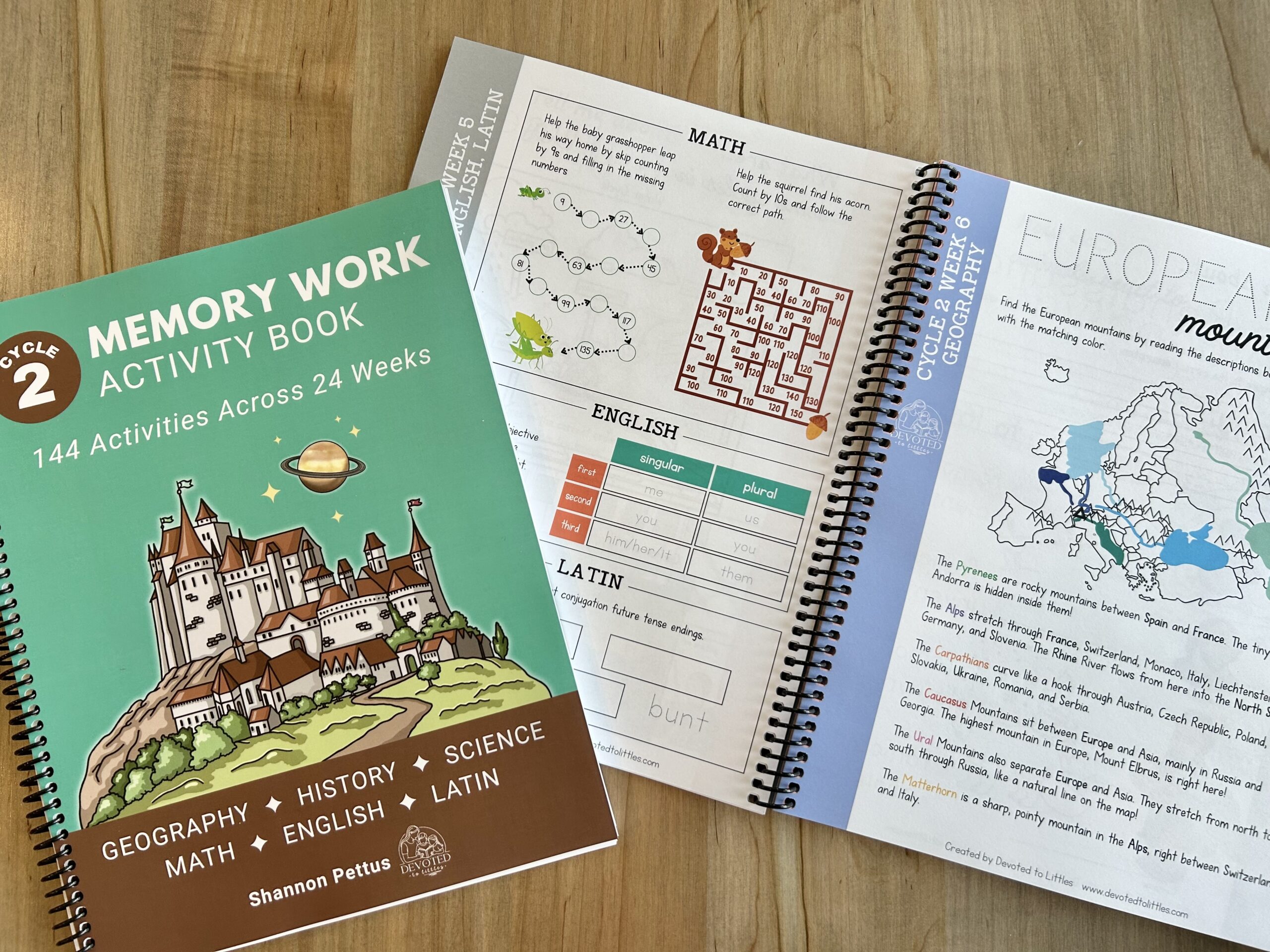
If you’re looking for a fun way to review the memory work at home with your kids this year, check out our NEW Cycle 2 Memory Work Activity Book. I created this notebook to give kids a fun way to practice their memory work, without adding extra prep for mom, dad, or grandma.
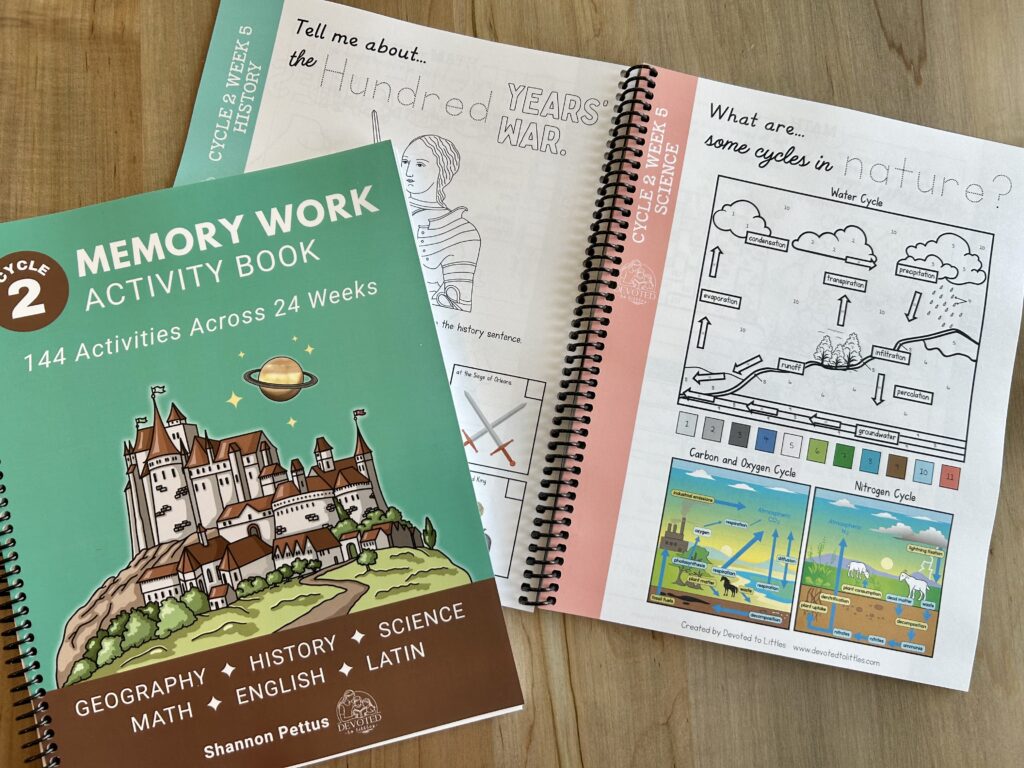
Inside, there’s one short activity for each subject for all 24 weeks of Cycle 2. When we do geography on Monday, they do the geography activity for that week. When we get to Thursday, they do the science page. It’s so easy to match to whatever we’re focusing on that day.
I love that it keeps things simple and fun. It’s NOW available in digital and printed form, and there is a sample page you can take a peek at if you would like too! Check it out below!
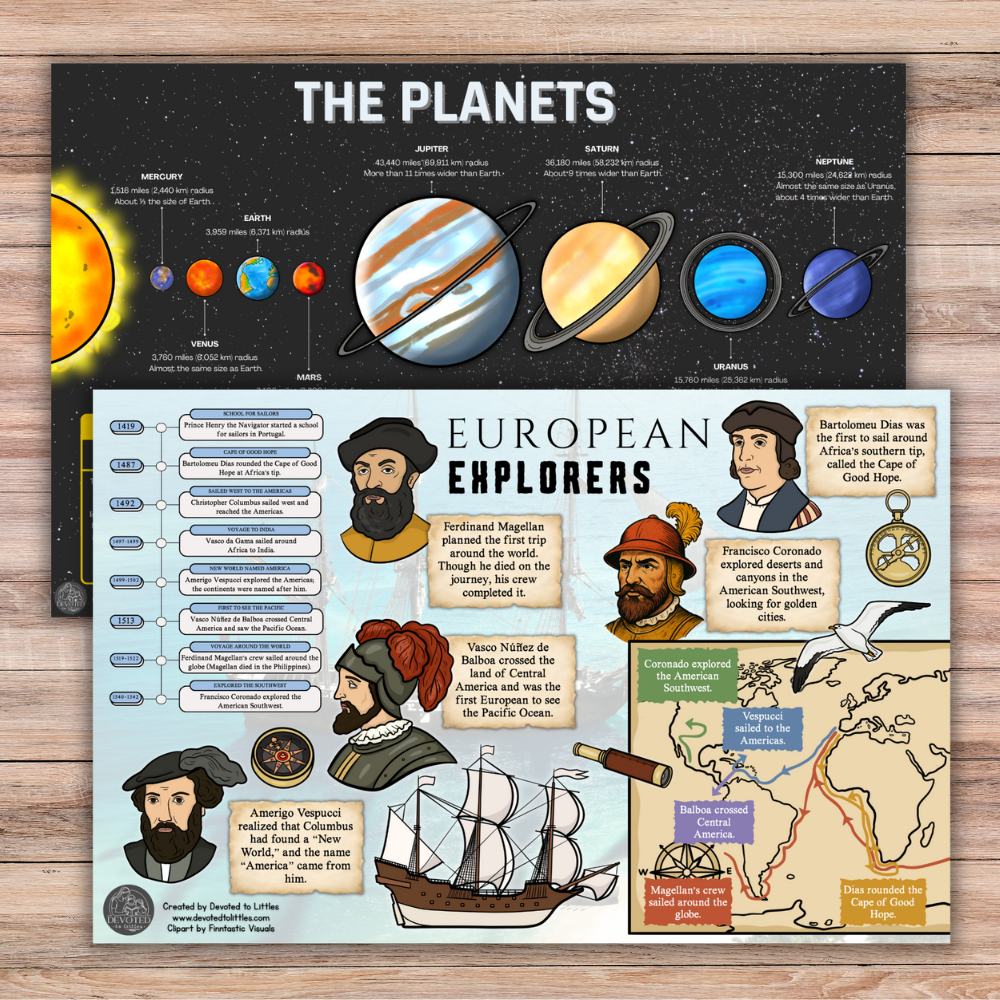
NEW Cycle 2 History and Science Placemats
These brand-new Cycle 2 History and Science Placemats are designed to make memory work fun and interactive for kids, whether you’re using them alongside Classical Conversations or on their own as a way to dive deeper into history and science.
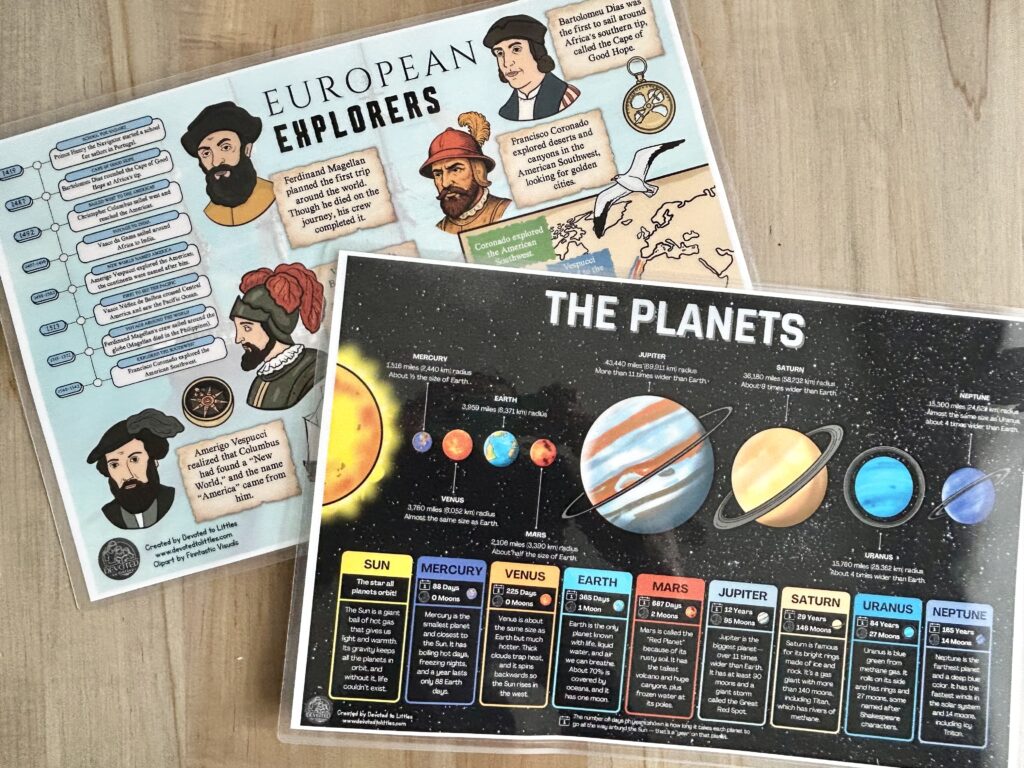
Each placemat is filled with colorful visuals and simple explanations that bring the topics to life. Just print, laminate, and use them again and again during meals and review time. They’re an easy, no-prep way to dive deeper into the history and science topics with your kids. Get your set for Weeks 7-12 below. Weeks 1-6 are also available HERE! Future weeks will be available soon!
Cycle 2 Pronoun Memory Cards
These Pronoun Memory Cards cover all 75 pronouns from Cycle 2, Weeks 4–13 and can be used in three different games. Each card includes a sentence, a colorful image, and the pronoun type, making it easy for kids to connect meaning with usage.
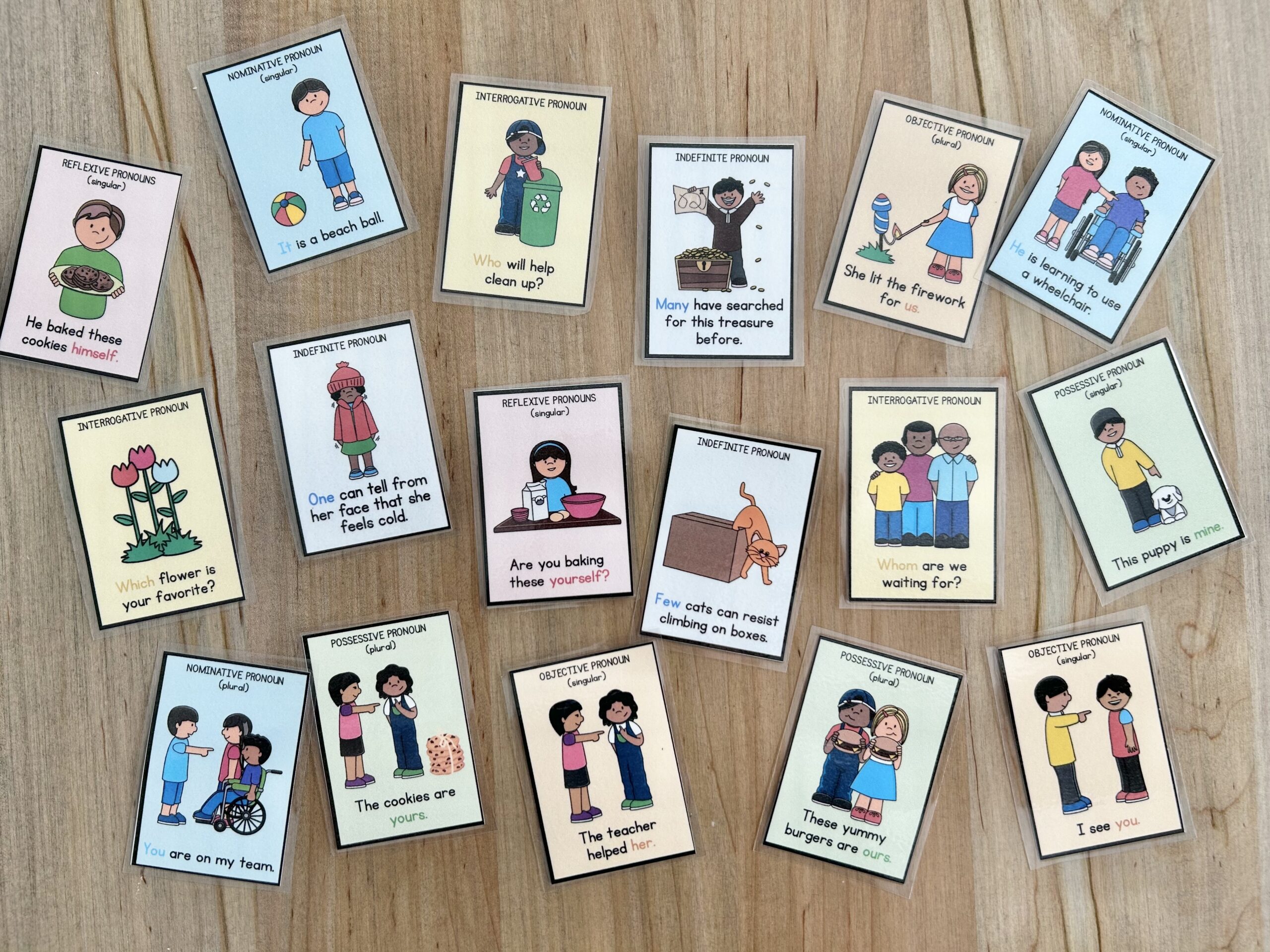
You can sort them by pronoun type, play a classic memory match, or try the fill-in-the-blank version for an extra challenge. My kids loved playing, and it gave them tons of practice without it feeling like drill. This set has quickly become one of our favorite go-to grammar review tools!
Cycle 2 Geography Passport
We also have a fun addition for geography review — the Cycle 2 Geography Passport! Whether you’re a tutor or a homeschool parent, this printable resource helps kids track their Classical Conversations Cycle 2 geography week by week with full-color maps and matching cut-and-glue stamps.
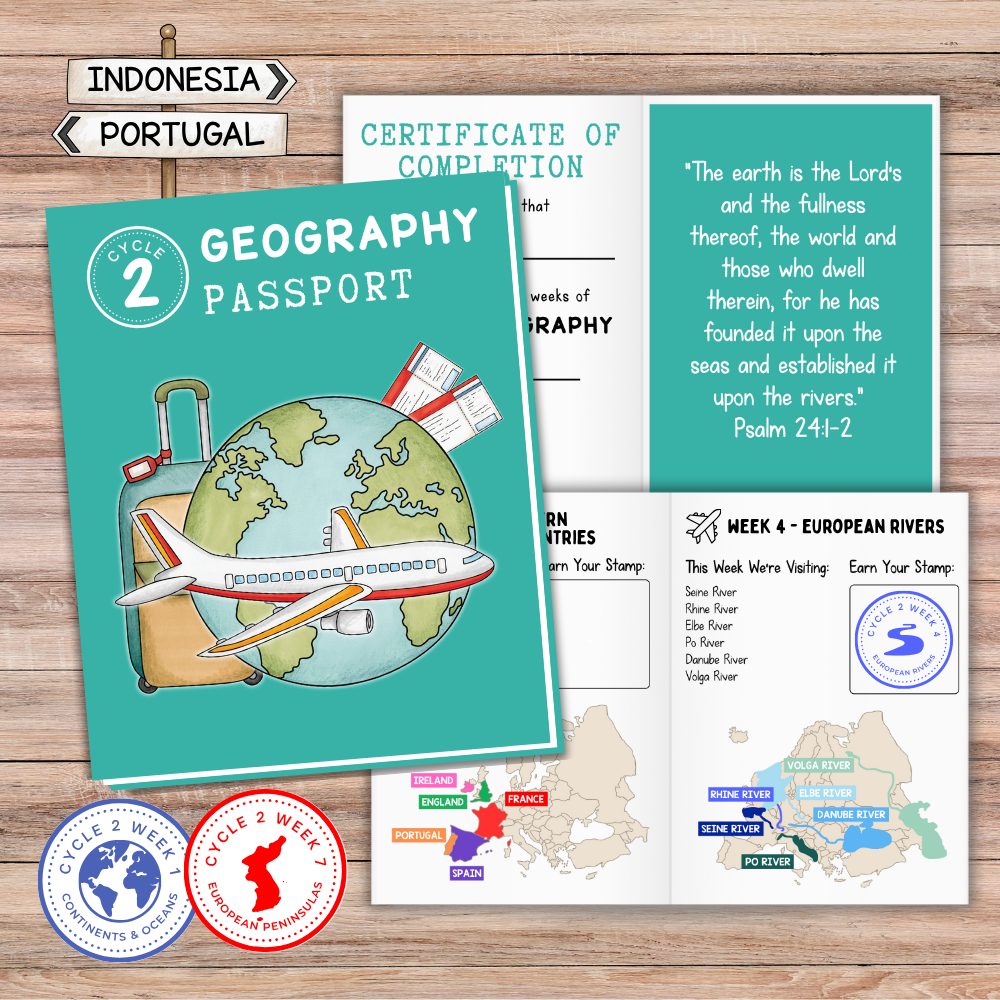
Each page highlights that week’s memory work with clearly labeled locations, making it easy for young learners to connect what they’re memorizing with what they see on the map. Kids love collecting stamps as they “travel” through the world. You can also print these stamps on these sticky circular labels which makes it even more fun!
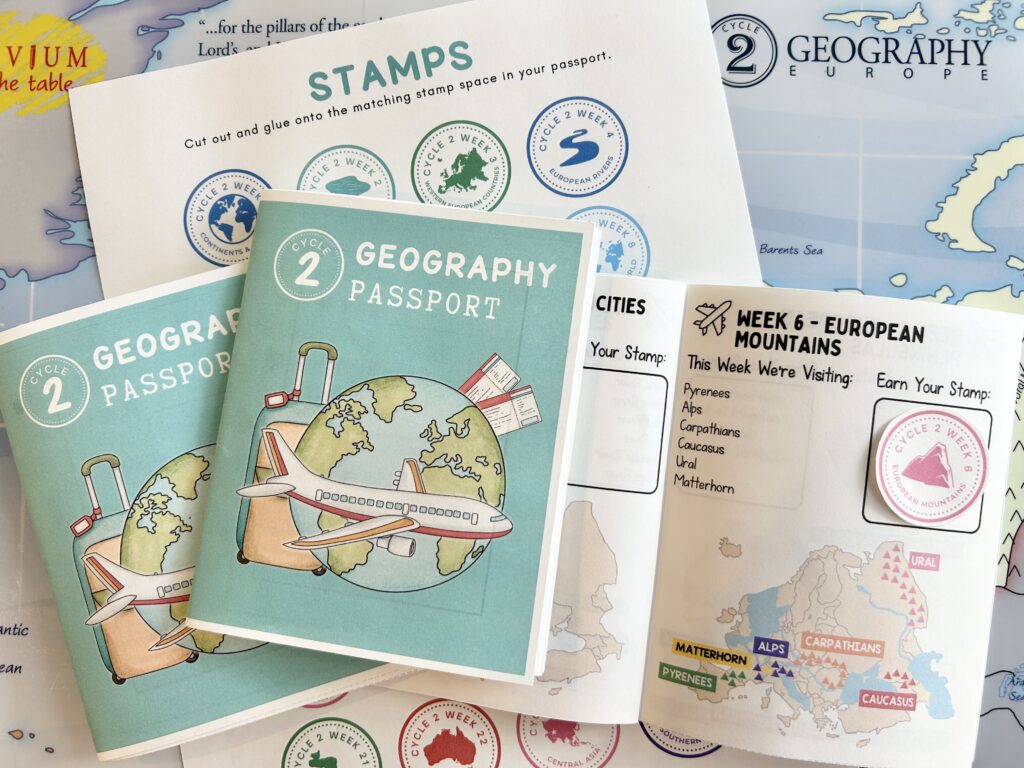
You can use the Geography Passport at home with your own children, or print it out for use in class. A group license option is available if you’d like to use it with your tutoring class or community group.
It pairs perfectly with the Cycle 2 Memory Work Activity Book, giving your students or children a hands-on, engaging way to practice their memory work all year long. If you’d like both resources, be sure to check out the bundle option available in my shop!
Memory Work Wonderland
Another one of our favorite ways to review is with fun, themed board games. I created a set of Candyland-style games that make memory work review exciting and interactive for kids. These games can be used with any cycle and are a great way to practice all of the memory work subjects together.

We’ve been playing Memory Work Wonderland, a Christmas/winter-themed review game (since Christmas is fast approaching!). It works just like Candyland, but with the addition of memory work review built in. Players move along the board by drawing cards with color blocks or picture spaces, then answer a review question that matches the space they land on. Correct answers let them stay put, but if they miss, they move back. The game also includes fun twists with slides and ladders to keep things lively. The first player to reach the cozy Christmas cabin wins!
The best part is that I now have a fall version, a winter version, and a spring version, so you can rotate them throughout the school year. You can grab each one individually, or get the seasonal bundle with all three at a special price.
These games have been such a hit in our home. They are perfect for community review days, family game nights, or just a fun way to end your homeschool week. You can find them all in my shop below.
Printable and Editable Cycle 2 Week 7 Tutor Plans
Here is a printable EDITABLE template of these Cycle 2 Week 7 Tutor Plans. Here is a blank template too! If you want the plans as they are, here is a PDF version (filled out) and a PDF version (blank).

Also, be sure to check out my post about teaching the Tin Whistle these next few weeks! I have a FREE Tin Whistle Plans and Activity set that you can download with lesson plans and activities for each week!

Cycle 2 Week 7 Memory Work Games

Also check out the FREE activities and games that you can use at home to help your kids practice the memory work this week.
I hope this helps give you some ideas and songs to use whether you are a tutor or a parent. Please comment below if you have any questions about anything.
Blessings to you on this homeschooling journey!


