
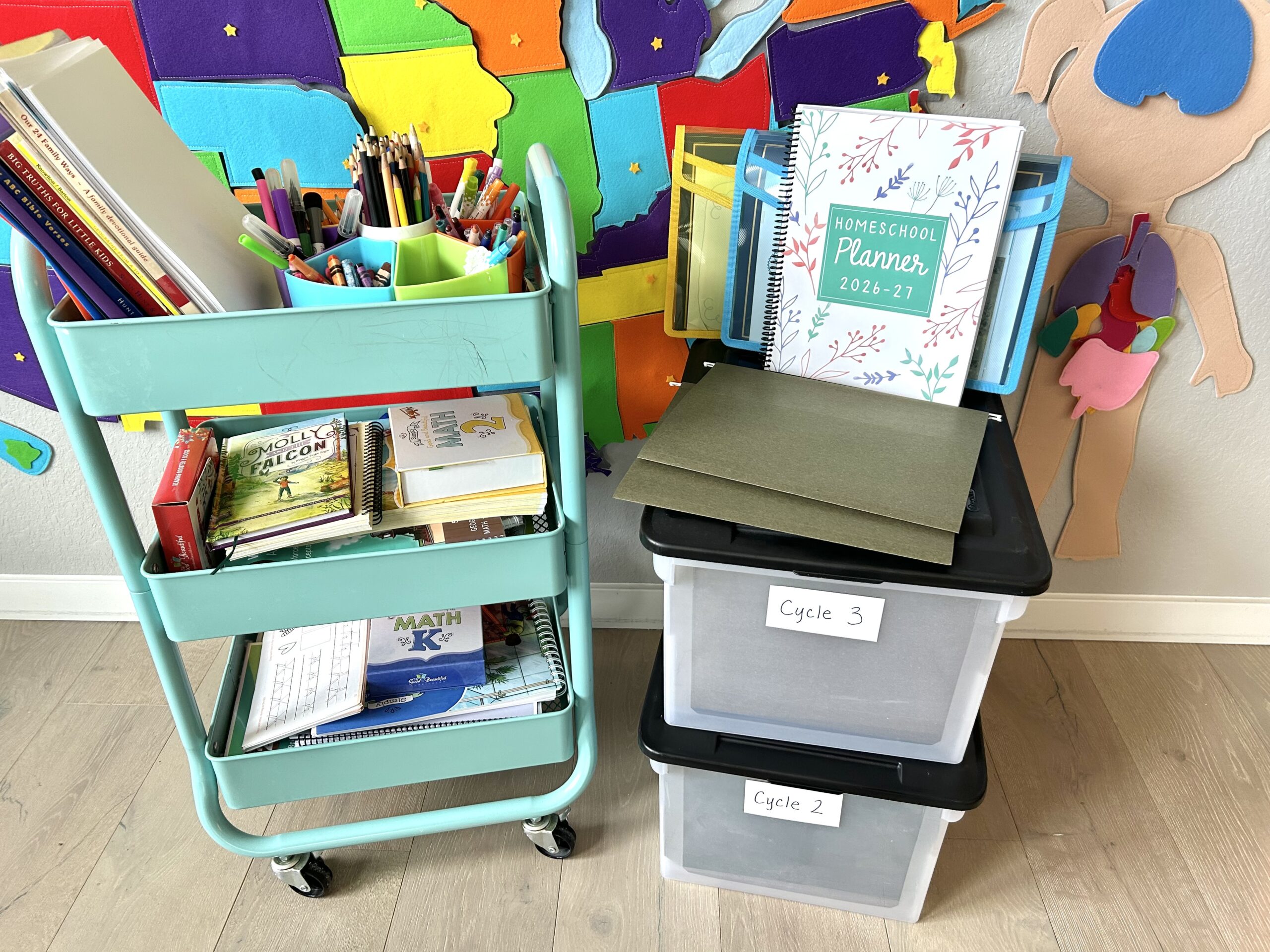
Homeschool Organization Tips for the End of the Year + Planning Ahead for Next Year!
The end of the homeschool year is such a sweet time. You get to look back at everything your kids have accomplished, celebrate their growth, and take a deep breath before the next year begins. But if you are anything like me, it also comes with a big pile of papers, activity books, games, and materials that need to find a home. That is where having some good homeschool organization tips makes all the difference.

Over the past few years, I have figured out some systems that really work for our family. They help me save the things that matter, organize the things I want to reuse, and keep our homeschool space from feeling cluttered and overwhelming. Today I want to share what has been working for us and also tell you about my brand new homeschool planner for the 2026-2027 school year!
This post contains affiliate links, which means I make a small commission at no extra cost to you. See my full disclosure here.
Expanding File Folders for Each Child
This has been one of my very favorite organization tools. At the end of the year, I go through each child’s papers, certificates, completed activity books, and anything else I want to save and put them into an expanding transparent file folder.

What I love about these expanding file folders is that they are the perfect size to save the important things without letting me save too much. That is key for me. I tend to want to hold onto everything, but having a folder with a set amount of space forces me to be intentional about what I keep. I go through the papers and choose the ones that really tell the story of our year and show what each child accomplished.
When I am done, each child has their own folder that is like a little story of their school year. It shows what they learned, what they worked on, and how much they grew. It is such a special keepsake, and it feels so much better than having a random box of papers stuffed in a closet.
File Folder Tubs Organized by Cycle
I love using these file folder tubs and these hanging file folders for organizing materials by cycle. I have a tub for each of the three cycles, and inside each tub I have a hanging file folder for each week. This has been a great way to store materials in the week where they belong, especially laminated pages and games that I plan to reuse.

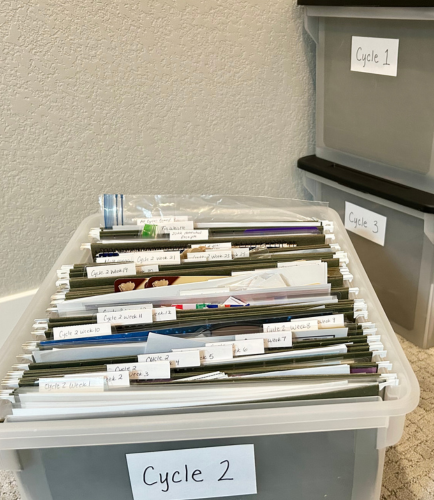
By the end of the year, I usually have a pile of papers and materials that I have not organized yet. Having these tubs makes it so easy to sort through that pile and drop things into the correct week. Then when it is time for that cycle again, I can just go to the tub and start looking at what I saved from each week the last time we went through it. It saves me so much time when I am planning because I do not have to start from scratch.
For example, as I start planning for Cycle 3 next year, I can go straight to my Cycle 3 tub and see what I already have for each week. Games I made, pages I laminated, resources I gathered. It is all right there waiting for me.
Binders with Weekly Printouts
I have been using binders with weekly printouts organized by cycle. Each cycle has its own color, which makes them easy to grab quickly.
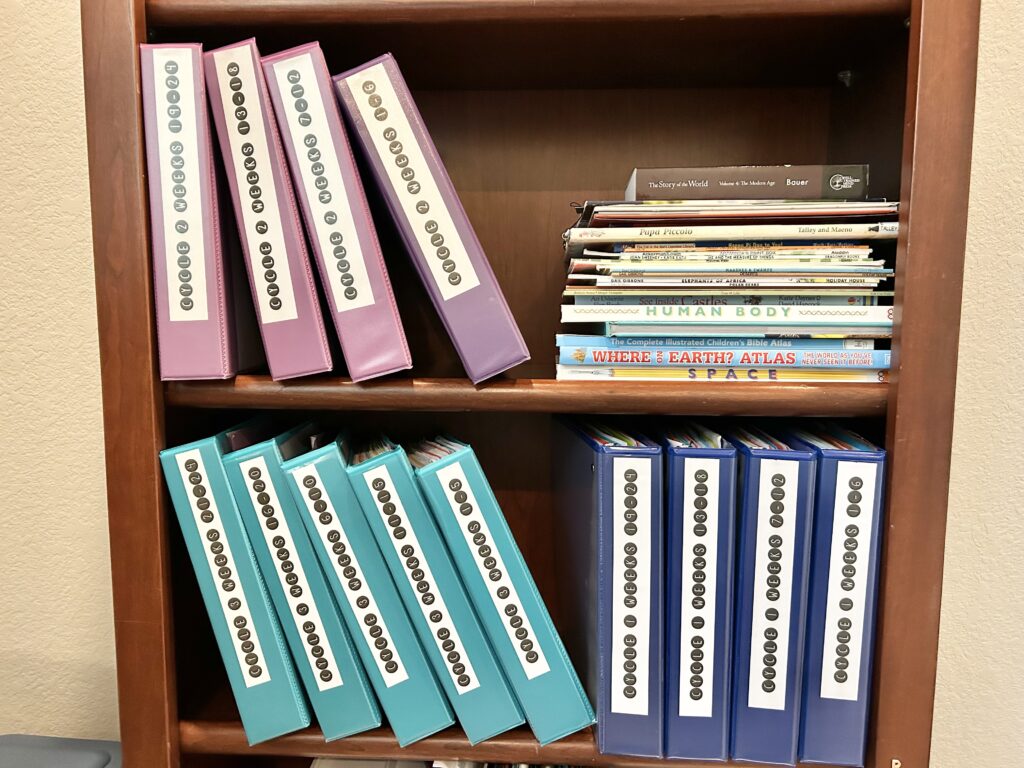
But I want to be honest with you. I am putting less and less in these binders, and I am not sure I will need them much longer. Since I have been using more activity books instead of printing out individual pages, I can just save the whole activity book at the end of the year instead of organizing a bunch of different single sheets. That has been so nice and has simplified things a lot.
I still like the binders for some things, but next year I might scrap them altogether. What I have found works even better is having a file folder for each child where I put any papers they did throughout the year that I think are worth saving. Then at the end of the year, I go through those papers and move the ones I really want to keep into the expanding file folder. I just did this and it felt so good to have a simple system that does not involve sorting tons of loose papers into binders.
The Rolling Cart That Changed Everything
One of the most helpful organizing things I have done this year has been using a rolling cart with a shelf for each child. On each child’s shelf they have their math and language arts books, their memory work activity book, and any other activity books, passports, or daily materials we use regularly.
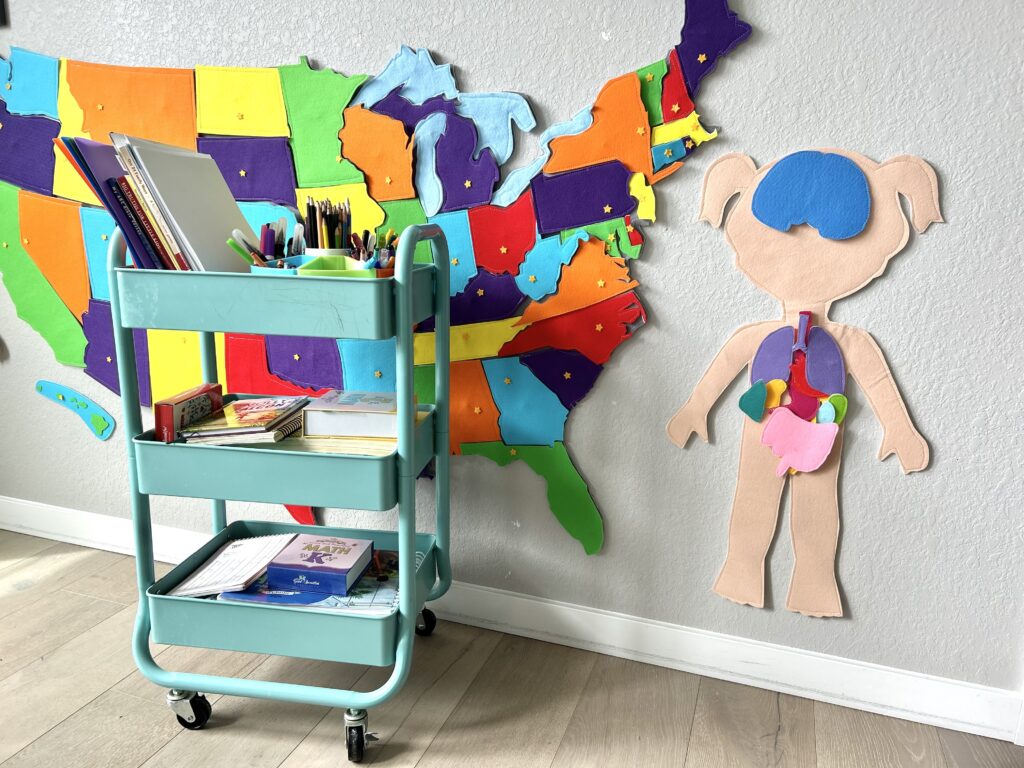
When it is time to do school, the kids go grab what they need from their shelf. When they are done, they put it back. Since we do a lot of our homeschool work at the kitchen table, I roll the cart out when we are doing school and then roll it back into the pantry when we are done. Just like that, it is back to being our regular kitchen table again. This has been a game changer for keeping our main living space from feeling like a permanent classroom.
On the top of the cart, I have a spinning container that organizes all our markers, crayons, and colored pencils. It makes it so easy for my kids to grab what they need without digging through a messy bin. Everything has a place and the kids can find what they need on their own.

Supply Caddies for Each Child
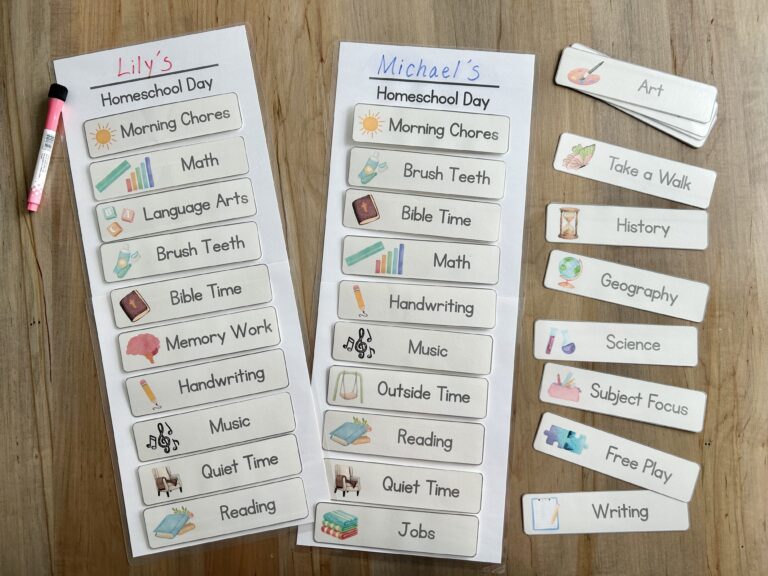
My girls also each have their own supply caddy where they keep their own packages of colored pencils, markers, and their homeschool daily rhythm cards. It works well for us for them to have their own colors. We also have shared colors in other places, but they really like having their own set too. It cuts down on the “she has the color I need” moments and helps everything run more smoothly.

Planning Ahead: My New 2026-2027 Homeschool Planner!
Now that we have talked about organizing everything from this past year, let me tell you about something that is going to help you start next year feeling prepared and excited. I am so thrilled to share my brand new 2026-2027 Homeschool Planner!

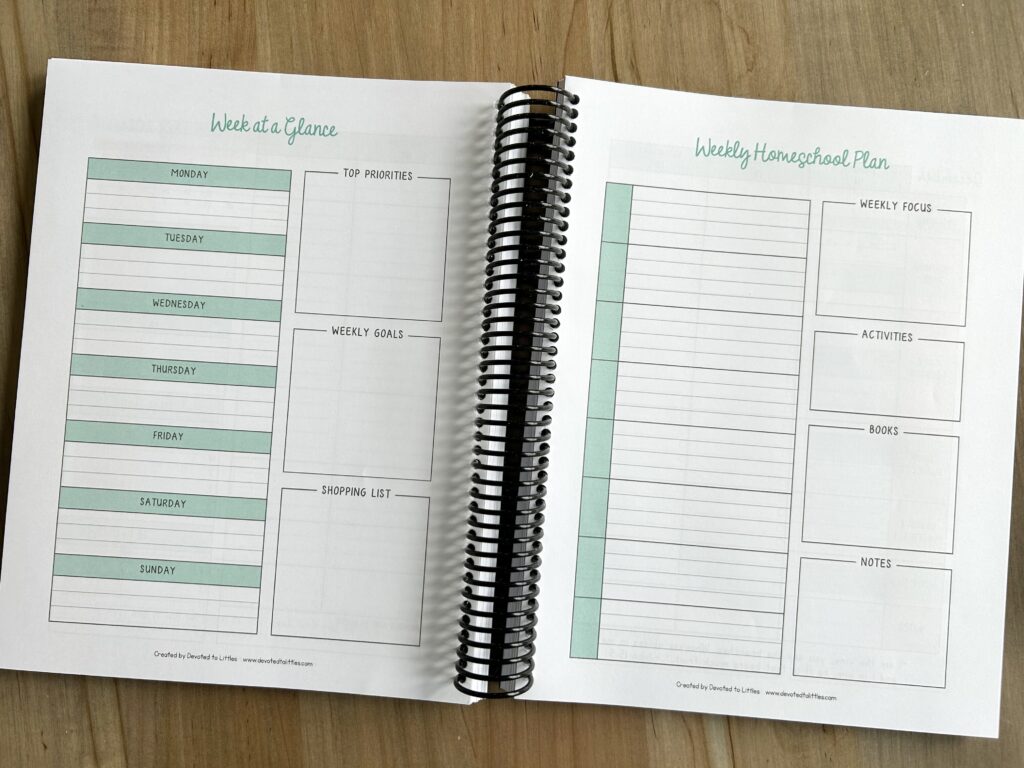
This planner covers 14 months from June 2026 through July 2027, giving you space to plan out your week, organize your lesson plans, track habits, plan meals, and log attendance. From morning time and core lessons to loop subjects and praises and prayers, this planner is designed to help you stay focused, faithful, and joyful through every season of your homeschool year.
Three Editions to Fit How You Plan
I wanted to make sure every family could find the right fit, so this planner comes in three editions. Each edition also comes in a filled version and a fully blank version.
The Standard Edition is the full 14 month planner with weekly spreads, monthly calendars, habit trackers, and all the planning tools. The filled version comes pre labeled with sections like Early Morning, Morning Time, Core Lessons, Loop Subjects, Books and Materials, Activities, and Notes, with a hand picked ESV Bible verse on every weekly page. The blank version has all the same dated calendars and tools but leaves the weekly sections and verse space empty so you can customize everything for your family.
The Weekly Planning Edition includes everything in the Standard Edition plus two page “Week at a Glance” and “Weekly Homeschool Plan” spreads placed before each week. This gives you even more room to map out your weekly focus, activities, books, top priorities, goals, and shopping list. The blank version leaves those section boxes unlabeled so you can fill them in with whatever categories fit your family.
The Cycle 3 Edition is built specifically for families doing Classical Conversations Foundations Cycle 3. It includes everything in the Standard Edition plus Cycle 3 specific weekly planning spreads with the CC memory work already filled in for you. Math, Latin, Science, English, Timeline, History, and Geography are all laid out so you can focus on planning your home days instead of copying memory sentences.

What Is Included in Every Edition
Every edition includes 14 months of weekly spreads with a Monday first layout, a meal plan column and to do list on every weekly spread, a dedicated Praises and Prayers section, monthly calendars with habit trackers, a curriculum planning page, daily rhythm page, year at a glance spread, reading log, book wishlist, field trip log, attendance tracker, homeschool expense tracker, holiday gift guide, and plenty of lined notes pages.
Every purchase also includes a bonus Cycle 3 Weekly Pages PDF with 24 single page layouts that have the memory work pre filled for each week. You can print only the weeks you need and slip them into your planner wherever your community’s calendar lines up.
Why You Will Love It
What I love most about this planner is that it is designed for the way homeschool moms actually plan. The Monday first layout keeps your school week front and center while grouping the weekend together. The detailed weekly sections are built for the rhythms of classical and Charlotte Mason homeschools. The Praises and Prayers space turns your planner into a record of God’s faithfulness throughout the year, not just a to do list. And the habit trackers, meal plans, and to do lists in every weekly spread mean you can keep your home and your school all in one place.
Whether you do Classical Conversations, Charlotte Mason, or any other style of homeschooling, there is a version of this planner that will work for you. You can find all three editions in my shop here!

Resources That Make Memory Work Fun and Hands On
We use a few key tools during our subject focus time that have made memory work feel simple, engaging, and enjoyable for my kids. Here is a look at what we use and love.
Memory Work Activity Books
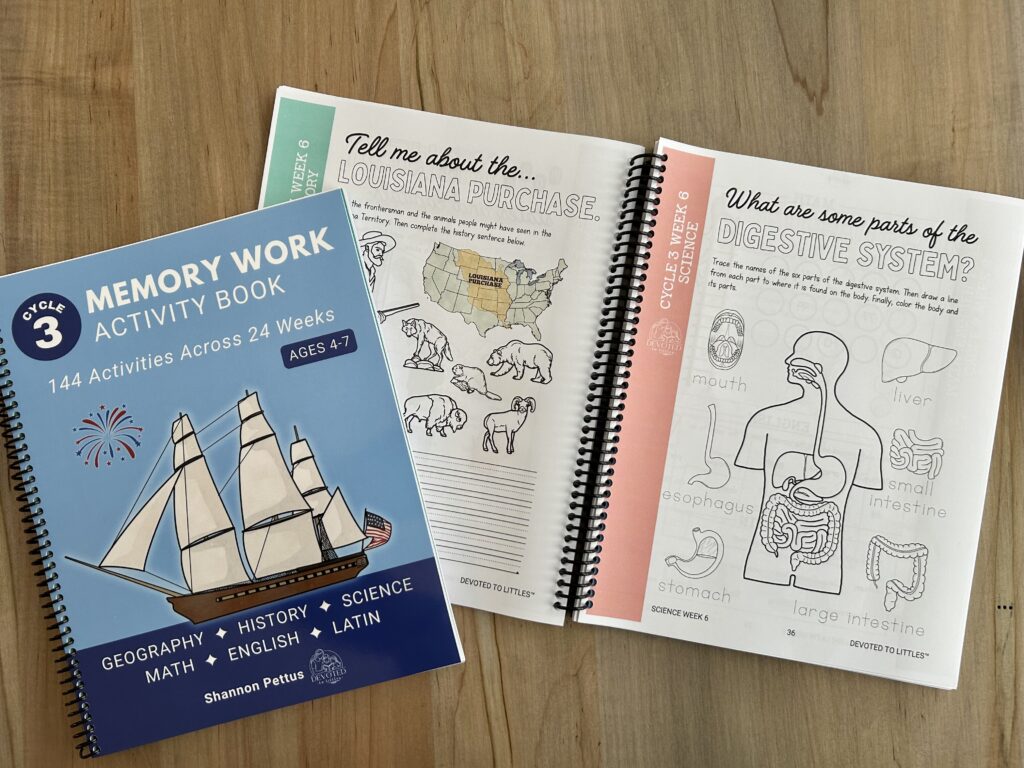
These have become one of our most used resources. Each book has a simple activity for every subject across all 24 weeks. So on geography day, my kids do the geography activity for that week. On history day, they work through the history page. It gives them something fun and hands on to do while they are learning, and it helps them really focus on that week’s memory work. My new Cycle 3 Memory Work Activity Book is COMING SOON and will be available for both 4-7 year olds and 8-12 year olds!
Placemats
Every day I set out the placemat that matches our subject focus for the day. Geography day? The United States placemat goes on the table. History day? The history placemat that aligns with that week’s memory work. Science day? Same thing.

I have placemats that cover the history and science memory work for all 24 weeks, and they are one of the easiest tools I use. We just read over them together at the table and it naturally sparks great conversations and helps us dig a little deeper into each topic with zero prep. You can grab these from my shop below!

Our Huge United States Felt Map
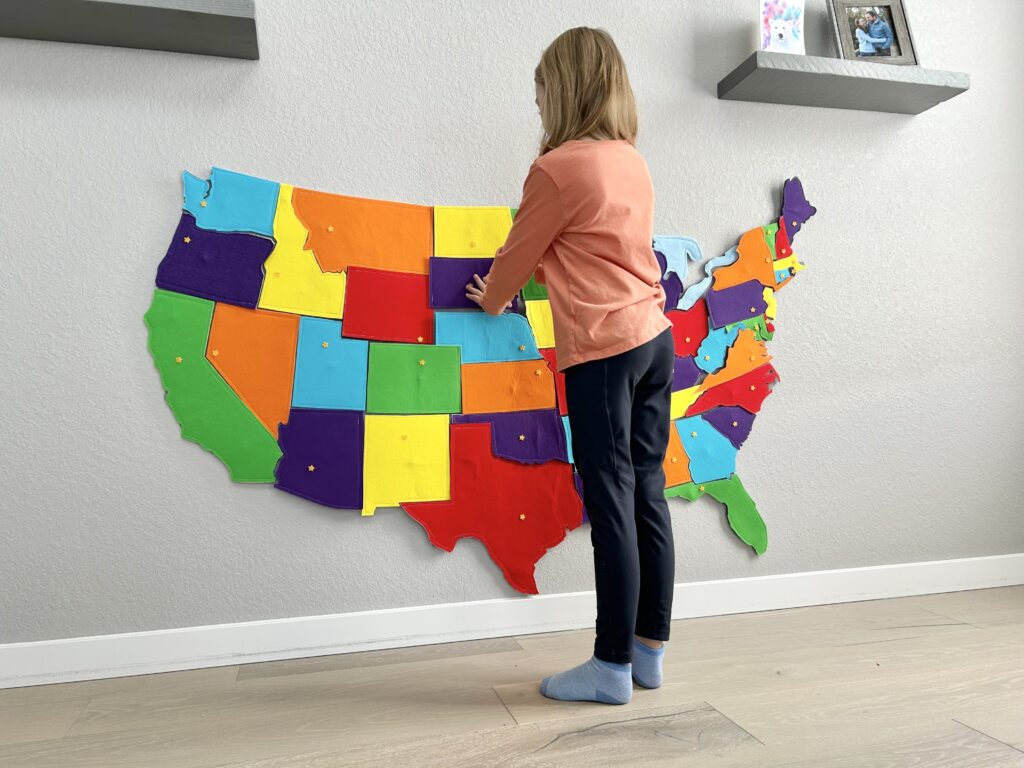
My kids absolutely love using our huge United States felt map during geography time, and honestly most other days too. Since we are learning all about the United States in Cycle 3 this year, this map has been one of our most used tools. They love pulling the states off and snapping them back into the correct spots. It makes geography feel like a game, and they are learning so much just from interacting with it over and over again.
Geography Passports and Workbooks
On geography day, we also grab our Cycle 3 Geography Passports and the kids get to add a stamp to the weekly page once they have mastered the geography for the week. I also have them dive deeper into a state or two using their United States Workbook since we are learning all about the United States in Cycle 3 this year. They do this during the geography focus day or other days too if we have extra time.

Felt Bodies and Science
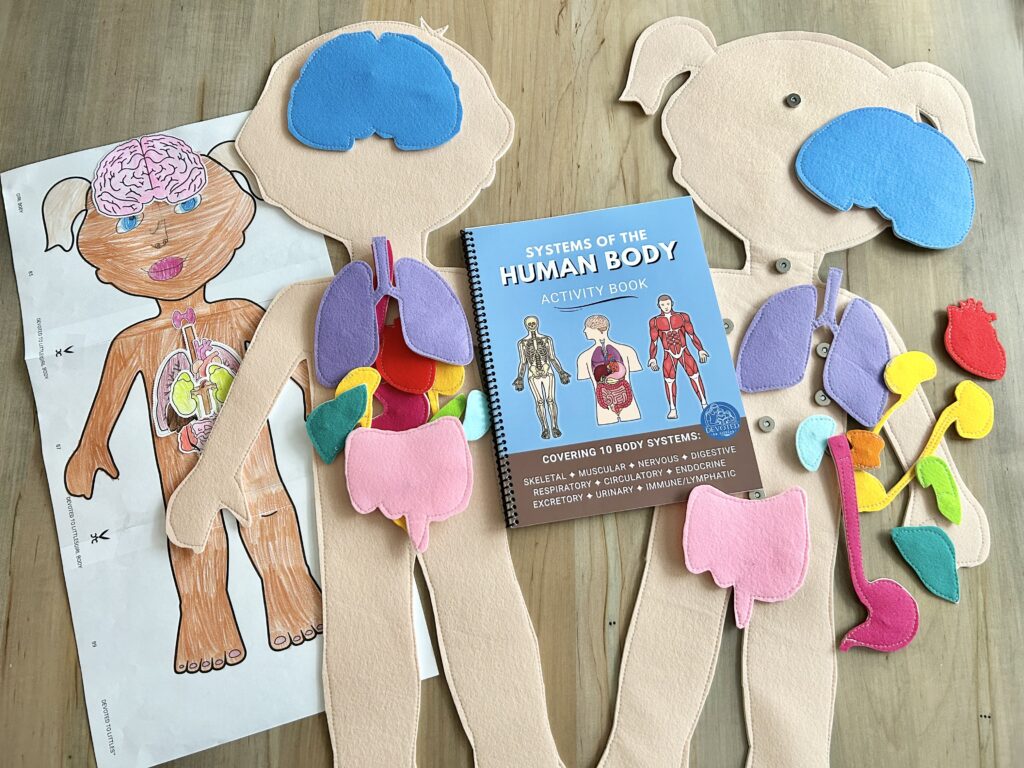
My girls also love snapping the body parts on and off of their felt bodies that we have on the wall by our breakfast table. They play with these all the time, not just on science days! On our science focus days, I also have my kids work on a few pages of their Systems of the Human Body Activity Book to dive a bit deeper into the body. It is a fun way to build on what they are memorizing and help them understand how everything connects.
Start Fresh and Organized
The end of the school year is the perfect time to get organized and set yourself up for a great year ahead. Take a little time to sort through this year’s materials, save the things that matter, and put your reusable resources where you can find them next time. Then grab a planner and start dreaming about the year to come.
You do not have to have a perfect system. You just need something that works for your family and helps you feel less overwhelmed. These are the tools and systems that have worked for us, and I hope they give you some ideas for your own homeschool organization.
I hope this post was helpful! If you have any questions about how I organize our homeschool materials or about the new planner, please comment below. I would love to hear what organization systems work for your family too!


We are very excited about your new cycle 3 resources! They look amazing! I was wondering if the cycle 3 edition of the planner is going to be available in the printed format?
Hi Rachel,
I don’t currently have the Cycle 3 version in the printed but I can if you’re interested! I just didn’t yet since people have different schedules that they are doing CC. Just let me know which weeks you would want the cycle 3 spread pages before and I can totally do that for you 🙂