

Cycle 2 Week 1 Tutor Ideas for Classical Homeschooling
We love being part of our Classical homeschooling community. Read more about how God redirected our path from private education to homeschooling and Classical education here.

This post contains affiliate links, which means I make a small commission at no extra cost to you. See my full disclosure here.
Are you new to the Classical model and want to know more about it? Keep reading below about how it’s organized, the different cycles, our community time, and MORE!
If you already know about the Classical homeschooling model and you are ready to jump to the actual tutor ideas, click HERE.
A Classical model of homeschooling
We are part of a Christ-centered homeschool program that follows the Classical model. The younger children, ages 4-12, focus on a memorization-based curriculum which acts as the groundwork of learning that is built upon in later years.
Children and their parents learn key facts across the core subject areas including history, science, English, mathematics, geography, and Latin. Tutors use fun activities, games, songs, and lots of energy to introduce the new material. The parents can then expand on that material at home throughout the week.
Cycle rotation
The material is divided into three cycles, which each last one year. The cycles continue to rotate every three years, so most children who start when they are kindergarten age, complete each cycle at least twice. This allows them to develop a deeper comprehension and grasp of the material through repetition.
Cycle 2 material
This year in Cycle 2, we’re learning about pre-Reformation to modern history, ecology, astronomy, and physics; Latin verb endings; English pronouns, adverbs, and conjunctions; skip counting, conversions, and more!
The following ideas are what I’m planning to do with the group of kids I am tutoring this year (ages 4-6). You may use these ideas if you are also tutoring in a Classical homeschooling community, or if you’re a parent who is looking for memory work ideas to use at home.
Also, you don’t have to be part of any particular Classical homeschooling group to use these ideas! These are ideas to help children learn key concepts in the core subject areas. If you are a homeschooling parent, or just a parent who wants to supplement what your kids are currently learning in school, these ideas will be helpful for you.
Community group time
Our homeschooling community has been meeting on Tuesdays. Our leader starts off the morning with everyone together in a big group setting. She typically begins that time with a devotional reading and prayer, and then continues with some announcements, celebrating birthdays, the pledge of allegiance, and anything else she wants to cover with everyone.
After this time, we split off into our different groups based on age. The tutors lead their groups into different classrooms and begin the New Grammar part of the day. This is when the tutor introduces the memory work for each core subject. Check out my post and video about how to make your own tutor board!

Cycle 2 Week 1 Tutor and Memory Work Ideas
New Grammar
Geography – Continents/Oceans
Young children do best when they know what to expect, so I like to begin class with Geography each week. I usually follow the same order for the rest of our subjects, but starting with something familiar helps the kids settle in and feel confident. I may shift things around later in class depending on their energy and focus, but I try to keep the opening consistent.

Geography this week focuses on learning the names and locations of the seven continents and five oceans. Each child receives a laminated world map that I make ahead of time. This is the laminator I have and use all the time and it works really well! I’ve also used this Epson printer for the past few years and I love it! I save so much on ink which is HUGE because I print A LOT as a homeschooling mama.
You can download this map and also use it with your class. I outline the continents in different colors with dry erase markers to make them easy to identify. First, we look at our maps together and practice pointing to each continent and ocean while I name them aloud. Then I teach a simple song to the tune of Yankee Doodle that names all the continents and oceans. We sing it together a few times while pointing to the locations on our maps. See my video below:
After that, I pass out small baggies filled with these animal stickers. Each animal corresponds to a continent or ocean. For example:
- Bear: North America
- Monkey: South America
- Horse: Europe
- Lion: Africa
- Panda: Asia
- Kangaroo: Australia
- Penguin: Antarctica
- The dolphin, whale, fish, seal, and shark are placed in the oceans

We take our time placing the stickers. I say something like, “Can you find the continent where the bear lives?” and then help them find North America. Once all the stickers are placed, we play a simple review game where I ask, “Who remembers where we put the penguin?” or “What ocean has the whale?”
At the end of class, the children get to take their completed maps home. This gives them something visual to help review the geography at home during the week.
English – Parts of Speech
For Cycle 2 Week 1, our English memory work introduces the parts of speech: noun, pronoun, verb, adverb, conjunction, interjection, preposition, and adjective. That is a long list of new vocabulary for little learners, but it becomes much more approachable when set to music and made playful.
After we say the list together a few times, I introduce a simple song to help them memorize the parts of speech. We sing the list to the tune of Are You Sleeping? and repeat it several times until the children became familiar with both the melody and the words. See my video below:
Then I pass out a set of silly voice cards. I made a new set for this year and you can download them for free HERE!

Each child receives a card with a fun way to speak, such as mouse voice, robot voice, pirate voice, or opera voice. After they each have a turn picking a voice, we sing the parts of speech again, using their assigned voices. Young children absolutely love this! Singing as a robot or squeaking like a mouse always adds laughter and keeps the group engaged while giving them repeated practice with the memory work. I plan to use these cards a lot this year!
This is also a great activity to continue at home. Your child can create silly voices of their own or even draw pictures of their favorites. You can encourage them to sing or chant the memory work using their silly voices throughout the week during playtime, in the car, or while getting ready for bed.
Silly Voice and Action Cards
Timeline
The timeline stays the same each cycle, and this week we begin with the first seven cards.
I often use these Timeline Cards in class: Set 1 (Ancient World), Set 2 (Medieval World), Set 3 (New World), and Set 4 (Modern World) I highly recommend investing in them (you should get all four sets) whether you are a tutor or a parent. I consistently use them as a tutor and also at home with my kids.

Since I have the 4-6 year old children, I like to tape the paper letter that the timeline event starts with at the top of the card. I have found these letters at my local Dollar Tree. Some of the children in my class can’t read yet, so this helps them identify the event I’m referring to.

Before our class time begins, I put seven pieces of painters tape on the wall and I hide the cards around the room. I try to pick spots that aren’t too difficult to find, but also not too easy. Then when it’s time to start Timeline, I tell the children to look around the room and see if they can find 1 or 2 cards (depending on how many children are in my group), and to bring them back to their seats.
I sing this week’s part of the timeline song as the children are looking for the cards. I sing it myself instead of playing the music so I can control the speed of the song. See my tutor video for the tune of this week’s timeline song.
When the cards have all been found and all the children are back in their seats, I go through each timeline event in the correct order and see which child has each card.
For example, I will say, “The first card is Age of Ancient Empires. What letter does “age” start with?”
A child answers, “It starts with the letter “A.”
I say, “Correct! Who has a card with a letter A on it?”
I instruct whoever has the correct card to walk up to where I have put the painters tape on the wall, and to stick the card to the correct spot on the wall. We repeat this for each timeline event until all the cards are on the wall in the correct order.


Then I have the students stand against the wall, each picking a timeline card to stand in front of, and I go over the timeline hand motions with the children. Then we sing the song together, trying to do the hand motions at the same time. See my video below which includes the hand motions for this week in the timeline section:
Math
This week in math, we focus on counting by ones and skip counting by twos. These early patterns help build number sense and prepare the children for multiplication later on.
To begin, we hop on one foot while counting aloud from one to fifteen. I model it first so they can see how it’s done, and then we all try it together. We take it slow and steady so no one loses their balance. As we hop, we count: “One, two, three…” all the way to fifteen. The movement helps them stay focused and makes it more fun than just saying the numbers out loud.
Next, we move on to skip counting by twos. This time we hop on two feet — one hop for each number in the skip-counting pattern. We sing together:
“Two, four, six, eight, ten, twelve, fourteen, sixteen, eighteen, twenty!” See my tutor video for the tune of this song.
They love the challenge of keeping the rhythm while hopping. I encourage them to say the numbers loudly and clearly as we go. We repeat it a few times, and then for fun, we hop backward or in a small circle as we say the twos again.
This simple change in movement keeps the energy up while giving them multiple ways to engage with the memory work. It’s quick, effective, and always a hit with this age group.
History
Our history sentence this week is about Charlemagne. To help the children remember this sentence, we play a game I call Gallop and Freeze. I bring in the paper towel roll horses I made last year. These have little horse heads cut out of felt and glued on the ends of paper towel tubes, with some twine or yarn, a few wiggle googly eyes and they are always a big hit with the kids. Here is the template I use for the horse heads in case you want to make your own. You can make them once and use them as much as you want throughout the year!
We begin by galloping around the room while singing the history sentence together. Every time we get to the word Charlemagne, I call out “Freeze!” and everyone stops in place like a statue. While frozen, we finish singing the sentence.

After the first round, I bring out a paper crown. One child at a time wears the crown and becomes Charlemagne, leading the rest of the class in a gallop around the room. Everyone gets a turn. The children love being chosen as the emperor and proudly guide the others through the room.
This activity gets them moving and singing the history sentence several times. See my tutor video for the tune of this song.
Science
This week’s science sentence focuses on what God creates on each of the six days of creation. I want the children to not only memorize the order but also enjoy and appreciate the beauty of God’s design.
We begin by singing the sentence to the tune of The Farmer in the Dell. See my video below:
We sing it slowly together a few times, and I teach the class simple hand motions to match each day:
- Day one: Flash arms open wide to show “light”
- Day two: Make a big sky arch with arms overhead
- Day three: Squat low and grow upward like a plant
- Day four: Circle arms for the sun, make a “C” for the moon, and twinkle fingers for stars
- Day five: Wiggle hands like fish, then flap arms like birds
- Day six: Stomp like animals and point to self and a neighbor for Adam and Eve

Next, we play a game using a large dice I have with clear plastic sleeves. Inside each sleeve is a picture representing one of the six days of creation. You can download and use these images of the six days of creation. Each child takes a turn rolling the dice. When a picture lands face up, we talk about what day it represents, sing that part of the song, and do the matching motion together.
The children love taking turns rolling the dice, and the hand motions help them remember what happens on each day.
Latin
Our Latin memory work this week focuses on the first conjugation verb endings in the present tense:
-ō, -s, -t, -mus, -tis, -nt
We start by singing the list together several times. I go slowly at first, then gradually increase the speed as they become more comfortable.
After singing a few rounds, I pass out these NEW action cards I made for this year. Each child receives a card with a different motion such as march, tiptoe, spin, jump, or flap like a bird. We stand in a circle and sing the Latin endings again while doing the assigned actions. After one round, we switch cards and repeat with new motions.

This keeps the kids engaged while they hear the Latin endings over and over. The physical activity helps the rhythm stick, and they enjoy the variety.
Since this is our very first week of Cycle 2, I keep review time simple and low-key. We don’t have any previous material to review just yet, so instead of doing a structured review game, I set out some playdough and give the kids a chance to relax and create while we sing a few of our new grammar songs together.
I keep a small stash of playdough in different colors and let the children pick which one they want. As they play, I sing a mix of songs we’ve already practiced during class, like the parts of speech, the days of creation, and skip counting by twos. I invite them to sing along with me, and many of them do without hesitation while they roll, squish, and shape their playdough into animals or silly creations.
This gives them a quiet and calming way to process the memory work we just learned, while still reinforcing it through song and repetition. It also gives us a little time to build classroom rapport without any pressure. In the coming weeks, I plan to add more review games and movement-based activities, but for now, this gentle and playful wrap-up is the perfect way to end our first class.
Also, you can download this Scientific Method sign to share with the children in your class as you do science each week. I enjoy singing a song to the tune “Pop Goes the Weasel” to help them remember each part!

Our NEW Cycle 2 Memory Work Activity Book
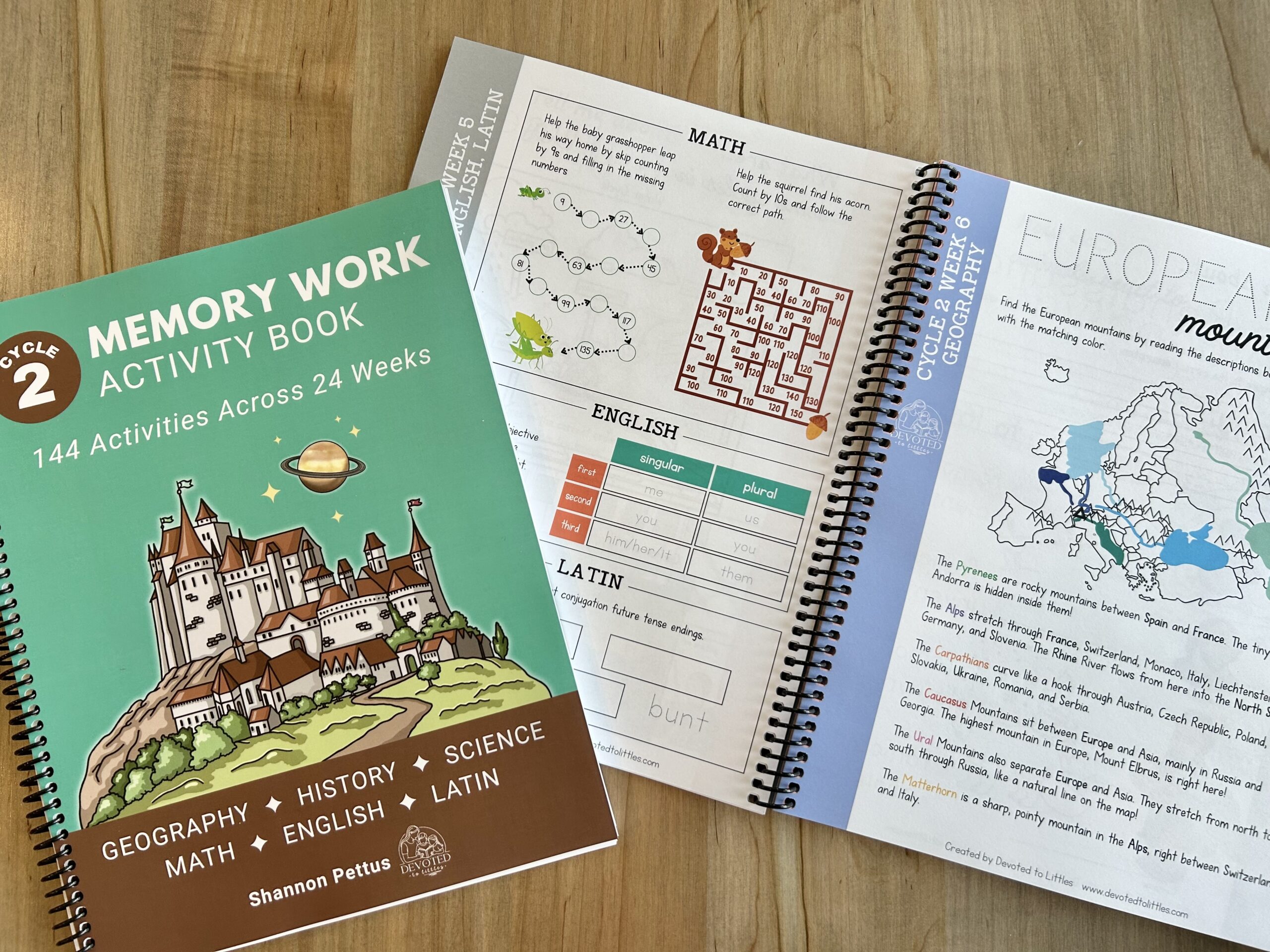
If you’re looking for a fun way to review the memory work at home with your kids this year, check out our NEW Cycle 2 Memory Work Activity Book. I created this notebook to give kids a fun way to practice their memory work, without adding extra prep for mom, dad, or grandma.
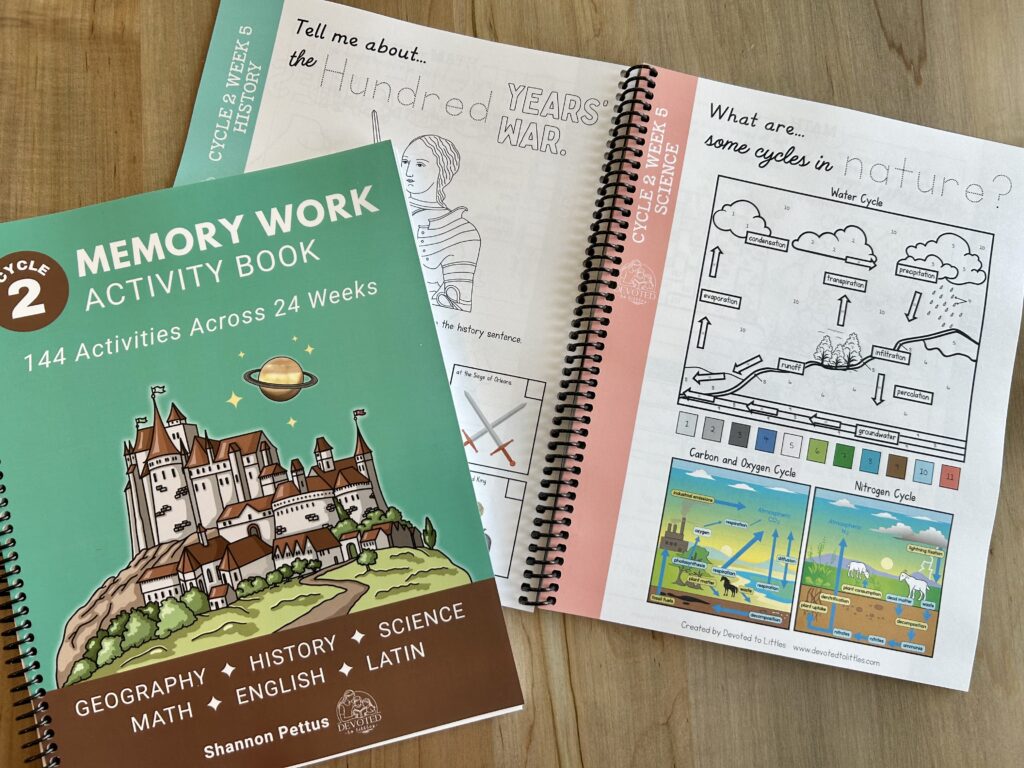
Inside, there’s one short activity for each subject for all 24 weeks of Cycle 2. When we do geography on Monday, they do the geography activity for that week. When we get to Thursday, they do the science page. It’s so easy to match to whatever we’re focusing on that day.
I love that it keeps things simple and fun. It’s NOW available in digital and printed form, and there is a sample page you can take a peek at if you would like too! Check it out below!
Cycle 2 Geography Passport
We also have a fun addition for geography review — the Cycle 2 Geography Passport! Whether you’re a tutor or a homeschool parent, this printable resource helps kids track their Classical Conversations Cycle 2 geography week by week with full-color maps and matching cut-and-glue stamps.
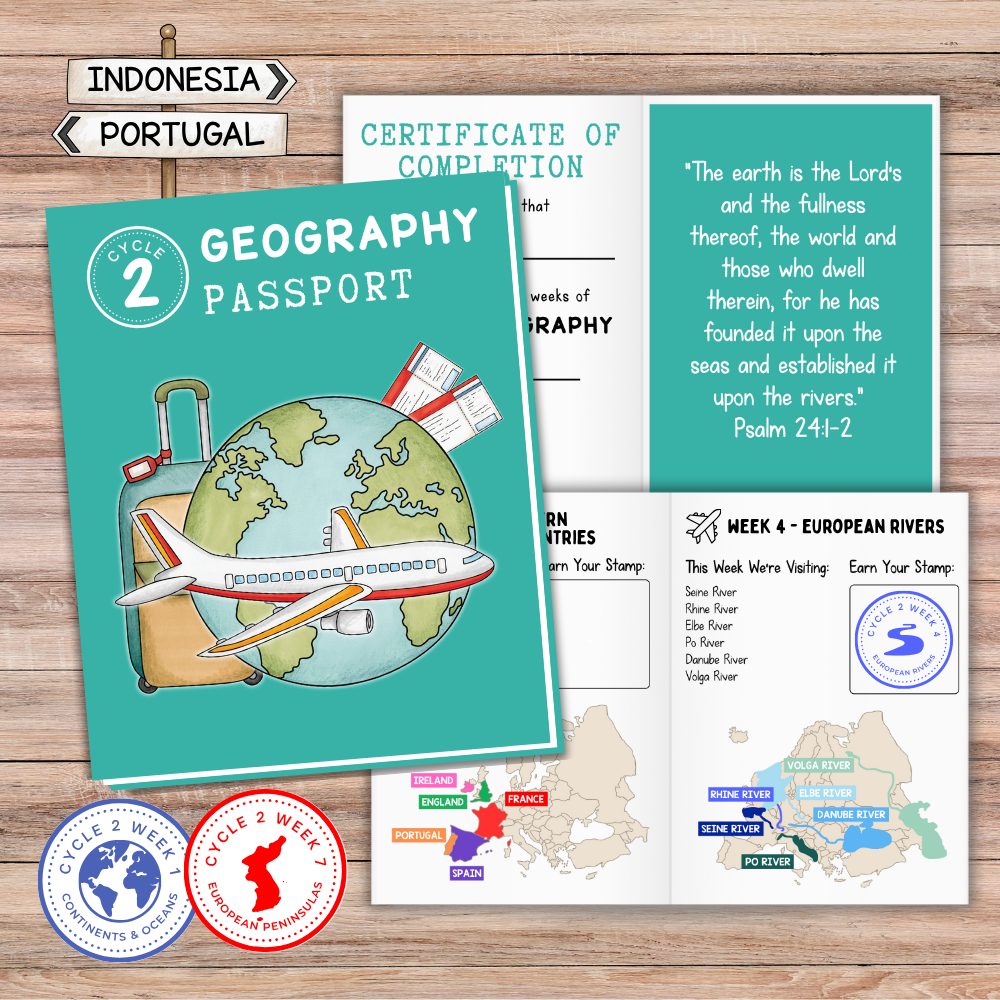
Each page highlights that week’s memory work with clearly labeled locations, making it easy for young learners to connect what they’re memorizing with what they see on the map. Kids love collecting stamps as they “travel” through the world!
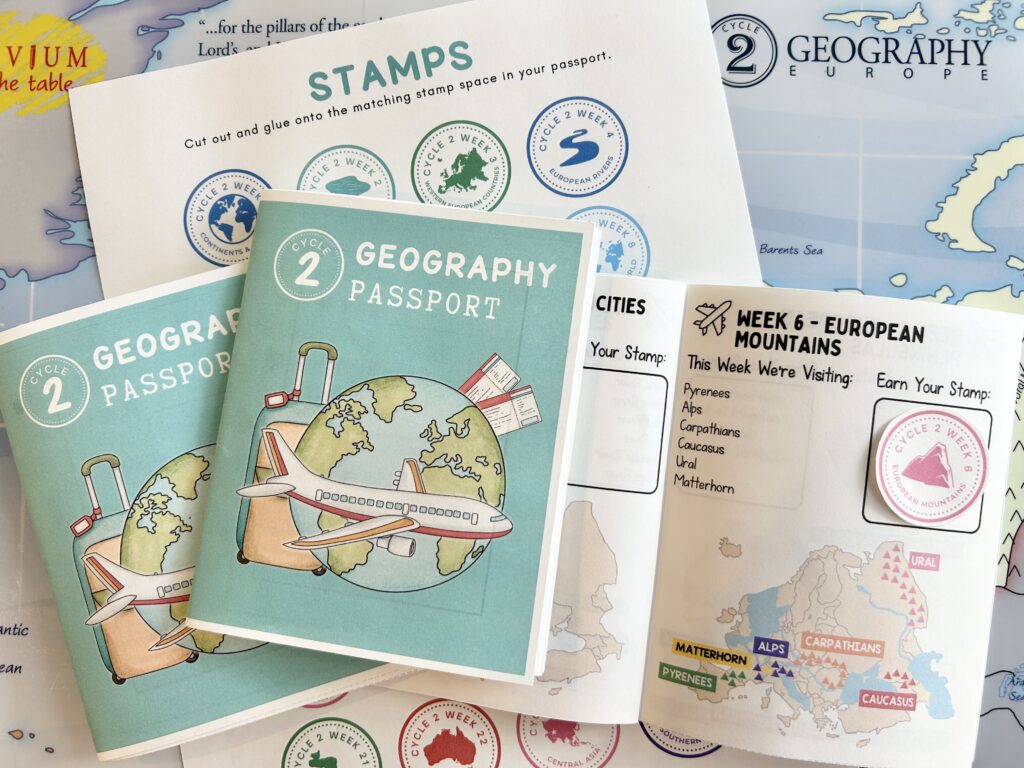
You can use the Geography Passport at home with your own children, or print it out for use in class. A group license option is available if you’d like to use it with your tutoring class or community group.
It pairs perfectly with the Cycle 2 Memory Work Activity Book, giving your students or children a hands-on, engaging way to practice their memory work all year long. If you’d like both resources, be sure to check out the bundle option available in my shop!
Printable and Editable Cycle 2 Week 1 Tutor Plans
Here is a printable EDITABLE template of these Cycle 2 Week 1 Tutor Plans. Here is a blank template too!
Cycle 2 Week 1 Memory Work Games
Also check out the FREE activities and games that you can use at home to help your kids practice the memory work this week.
I hope this helps give you some ideas and songs to use whether you are a tutor or a parent. Please comment below if you have any questions about anything.
Blessings to you on this homeschooling journey!


Truly so thankful to find you and your resources. Appreciate all your hard work in putting all this together! Excited for a great year in Cycle 2 tutoring for the first time with your help! You are a blessing!! Love from Louisiana
Oh thank you! That’s so awesome that you’re tutoring too!! 🙂
Where did you get the stickers?
Hi! I have the stickers I used linked in my blog post and I got them from amazon. You can go to the geography section using the link below and you should see the link when I start talking about the stickers. And I just bought 1 pack (there are a ton of stickers so it will last awhile). 🙂
https://devotedtolittles.com/cycle-2-week-1-tutor-ideas-for-classical-homeschooling/#cycle-2-week-1-geography
Can you tell me where you got the stickers? Was it one pack for all of those or a separate pack for each animal?
Thank you!
Hi! I have the stickers I used linked in my blog post. You can go to the geography section using the link below and you should see the link when I start talking about the stickers. And I just bought 1 pack (there are a ton of stickers so it will last awhile). 🙂
https://devotedtolittles.com/cycle-2-week-1-tutor-ideas-for-classical-homeschooling/#cycle-2-week-1-geography