Cycle 2 Week 5 Tutor Ideas for Classical Homeschooling
Whether you’re tutoring or simply looking for ideas to bring memory work to life at home, here’s a peek at what I’ve planned for Cycle 2, Week 5. I like to keep our activities hands-on, full of movement, and simple enough to make them easy to implement with little learners.
Please note, I am not affiliated with any Classical education organization; these are simply my own ideas and suggestions based on my experience as a tutor. I hope they encourage and inspire you as you prepare for Cycle 2, Week 5.
We love being part of our Classical homeschooling community. Read more about how God redirected our path from private education to homeschooling and Classical education here.
This post contains affiliate links, which means I make a small commission at no extra cost to you. See my full disclosure here.
Are you new to the Classical model and want to know more about it? Keep reading below about how it’s organized, the different cycles, our community time, and MORE!
If you already know about the Classical homeschooling model and you are ready to jump to the actual tutor ideas, click HERE.
A Classical model of homeschooling
We are part of a Christ-centered homeschool program that follows the Classical model. The younger children, ages 4-12, focus on a memorization-based curriculum which acts as the groundwork of learning that is built upon in later years.
Children and their parents learn key facts across the core subject areas including history, science, English, mathematics, geography, and Latin. Tutors use fun activities, games, songs, and lots of energy to introduce the new material. The parents can then expand on that material at home throughout the week.
Cycle rotation
The material is divided into three cycles, which each last one year. The cycles continue to rotate every three years, so most children who start when they are kindergarten age, complete each cycle at least twice. This allows them to develop a deeper comprehension and grasp of the material through repetition.
Cycle 2 material
This year in Cycle 2, we’re learning about pre-Reformation to modern history, ecology, astronomy, and physics; Latin verb endings; English pronouns, adverbs, and conjunctions; skip counting, conversions, and more!
The following ideas are what I’m planning to do with the group of kids I am tutoring this year (ages 4-6). You may use these ideas if you are also tutoring in a Classical homeschooling community, or if you’re a parent who is looking for memory work ideas to use at home.
Also, you don’t have to be part of any particular Classical homeschooling group to use these ideas! These are ideas to help children learn key concepts in the core subject areas. If you are a homeschooling parent, or just a parent who wants to supplement what your kids are currently learning in school, these ideas will be helpful for you.
Community group time
Our homeschooling community has been meeting on Tuesdays. Our leader starts off the morning with everyone together in a big group setting. She typically begins that time with a devotional reading and prayer, and then continues with some announcements, celebrating birthdays, the pledge of allegiance, and anything else she wants to cover with everyone.
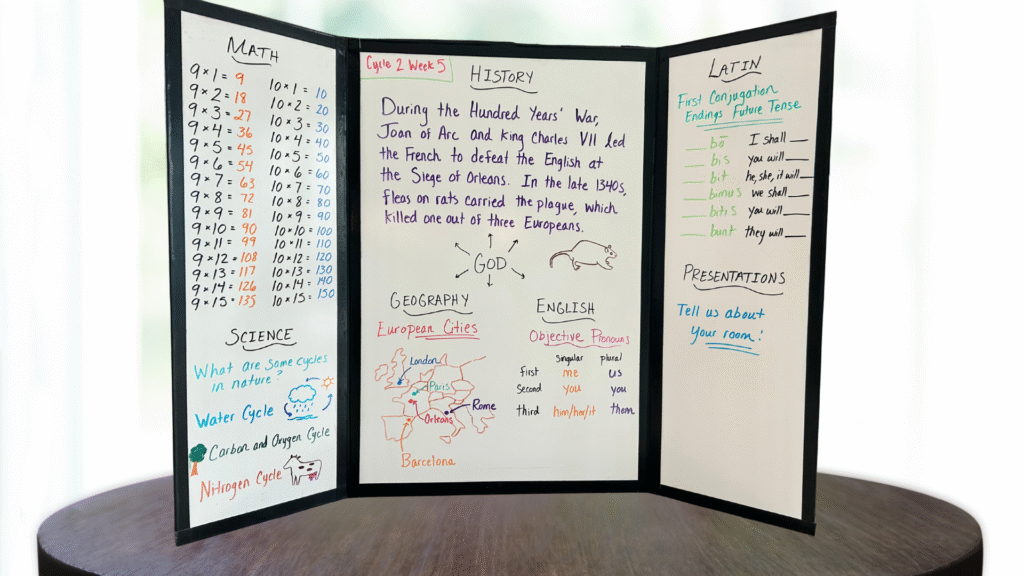
After this time, we split off into our different groups based on age. The tutors lead their groups into different classrooms and begin the New Grammar part of the day. This is when the tutor introduces the memory work for each core subject. Check out my post and video about how to make your own tutor board!
Cycle 2 Week 5 Tutor and Memory Work Ideas
New Grammar
Geography – European Cities
This week in geography we are learning about the European cities: London, Paris, Rome, Barcelona, and Orleans.
Before introducing the new material, we’ll take a few minutes to review the rivers we learned last week. Then we’ll set off on a new adventure—this time with Lego people! Each child will have a little Lego figure to “travel” with across their trivium table maps. I’ll outline the cities with different color dry erase markers so they stand out clearly.
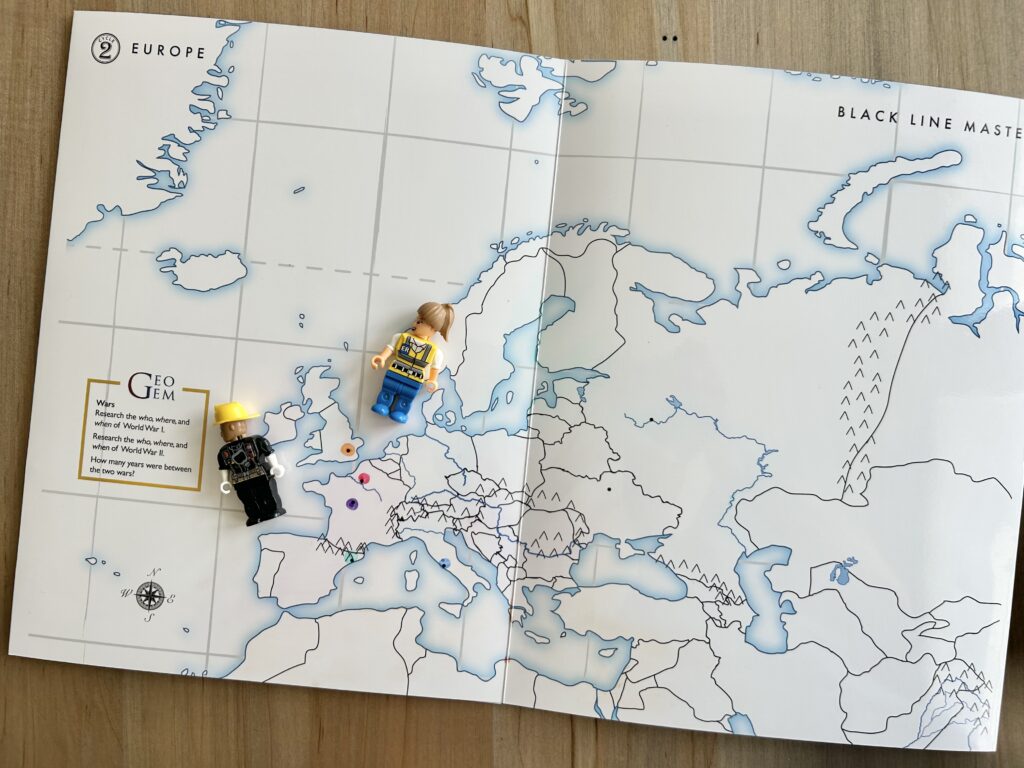
As we move from city to city, I’ll tell a short, rhyming story to help the kids remember the names:
- London – Our Lego friend rides a red bus in London town, up the hill and then back down.
- Paris – Next stop Paris, where he sees a beautiful ferris wheel.
- Rome – In Rome he sees the Colosseum dome.
- Barcelona – He enjoys an ice cream cone in Barcelona.
- Orleans – In Orleans, Joan of Arc was brave, trusting in God’s strength.
The children will move their Lego figures across their maps as I tell the story, stopping in each city along the way.
To make it stick, I’ll also teach them this short song to the tune of Row, Row, Row Your Boat. See my video below.
We’ll sing it several times while pointing to each city with our Lego figures, and the children will quickly begin to remember the names.
Finally, I’ll quiz them with color hints: “Who remembers what our Lego friend did in the orange city? How about the city where there was a ferris wheel?” This keeps it fun, interactive, and memorable.
English – Objective Pronouns
This week we are continuing with pronouns, moving into objective pronouns. We’ll keep using the same song we began last week to the tune of Here We Go Looby Loo. This way, the children can start stringing all the pronouns together from Week 4 through Week 13 in one continuous, fun song.
To begin, I’ll introduce just the objective pronouns for this week and sing them with the tune. Then I’ll invite the kids to join me, adding in our simple motions. Just like last week, we’ll swing our arms gently side to side in rhythm with the song. The movement keeps their bodies busy and helps their brains focus on the words, which makes memorization easier. Once we have the objective pronouns down we will sing the song from the beginning and include the nominative pronouns we learned last week.
Here’s the video if you’d like to use the same song and motions:
After practicing together, we’ll sing it a few more times in different ways: quiet voices, loud voices, whisper, etc.
Timeline
The timeline stays the same each cycle, and this week we continue with the next seven cards.
I often use these Timeline Cards in class: Set 1 (Ancient World), Set 2 (Medieval World), Set 3 (New World), and Set 4 (Modern World) I highly recommend investing in them (you should get all four sets) whether you are a tutor or a parent. I consistently use them as a tutor and also at home with my kids.

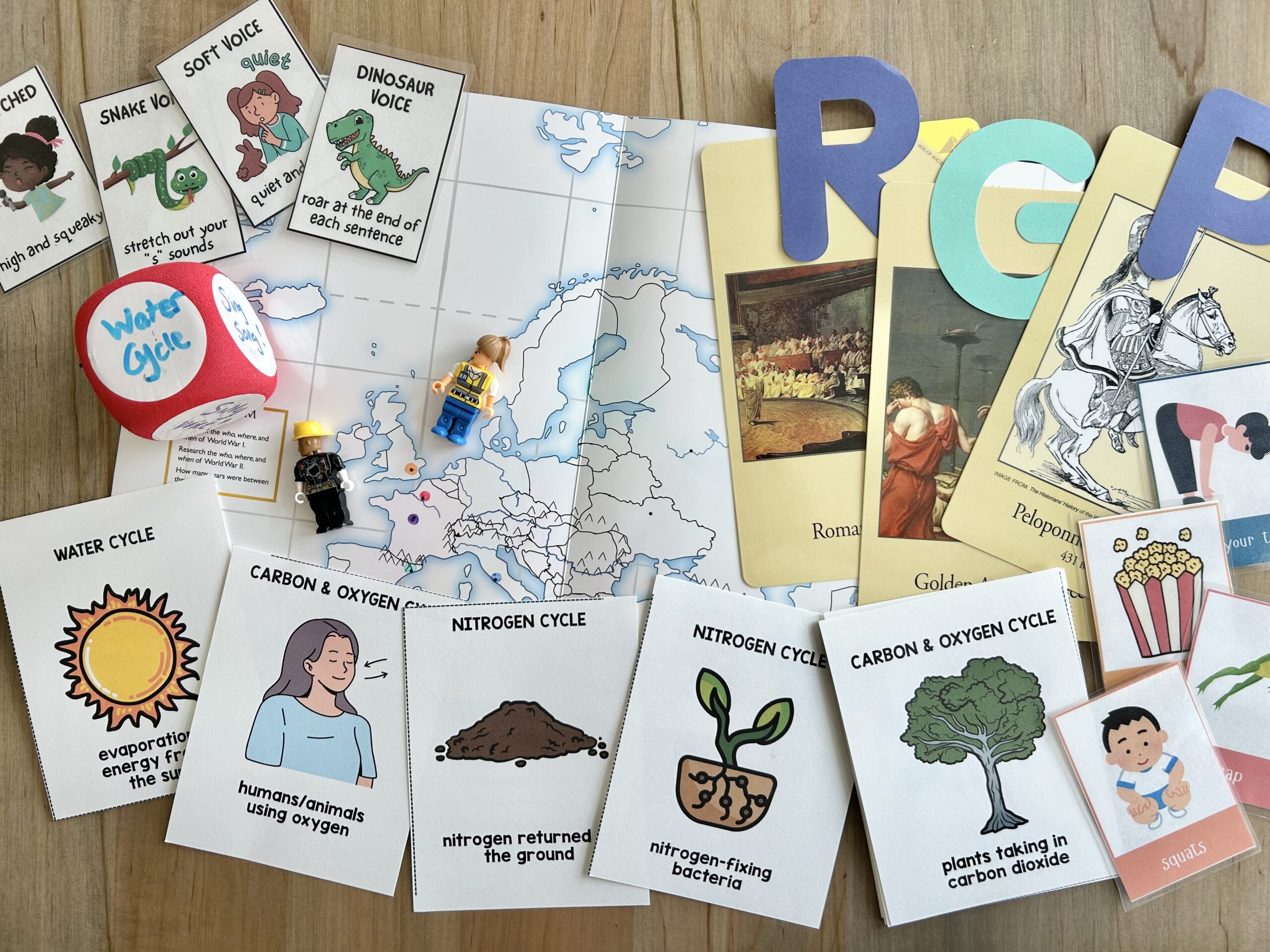
Since I have the 4-6 year old children, I like to tape the paper letter that the timeline event starts with at the top of the card. I have found these letters at my local Dollar Tree. Some of the children in my class can’t read yet, so this helps them identify the event I’m referring to.
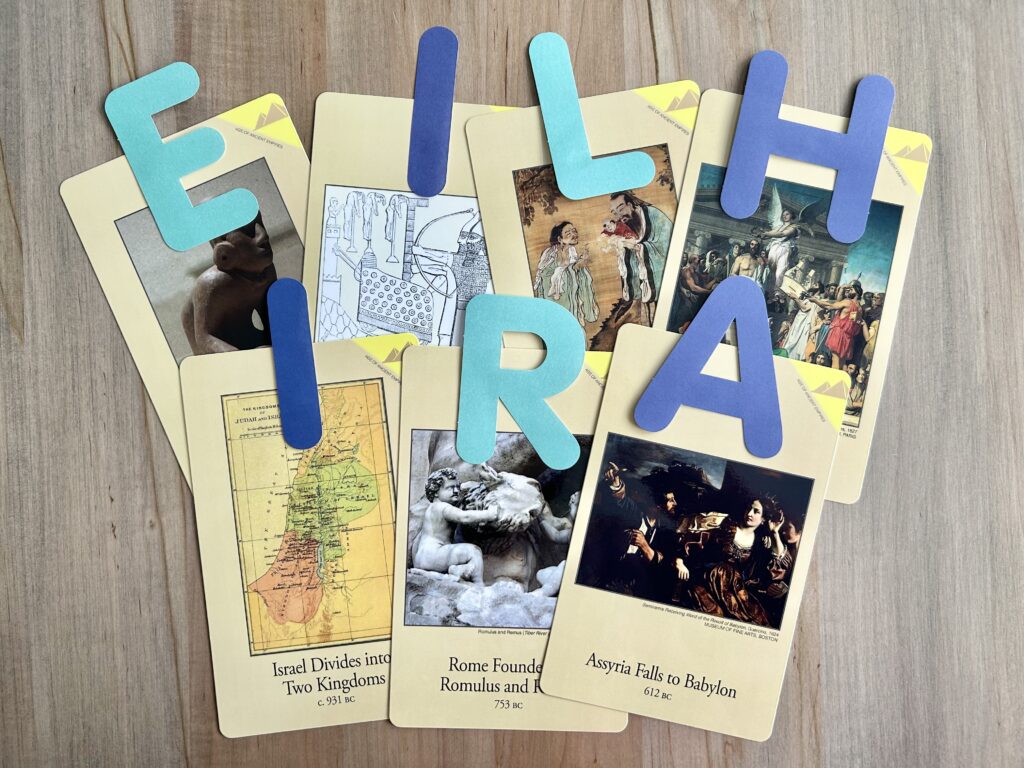
Cycle 2 Week 5 Timeline
Before our class time begins, I put seven pieces of painters tape on the wall. This week for timeline, we’ll start by singing this week’s portion of the timeline song together a few times. I like to practice it myself at home before community day so I feel confident leading the kids.
After that, we’ll play one of my class’s favorite games! I’ll choose two children to step outside with a parent volunteer while the rest of the group hides two timeline cards somewhere in the room. Both cards must be hidden in the same spot. Once they’re hidden, I explain to the kids that we’ll use the volume of the timeline song as a clue:
- If the searchers are close to the cards, we’ll sing louder.
- If they are far away, we’ll sing more quietly.
When the two children come back inside, they’ll search the room while the rest of us sing the timeline song as their “hot and cold” guide. Once the cards are found, the children place them on the wall with painter’s tape in the correct spot.
We’ll repeat the game until all the cards are found and placed on the wall. The kids absolutely love this activity, and it gives them many chances to hear and sing the timeline song over and over.
Once the wall is complete, we’ll review the motions together and sing the timeline song one last time, trying to keep the hand motions and words in sync. See my video below for this week’s motions:
Math
This week in math we are skip counting the 9’s and the 10’s.
For the 9’s, I’ll begin by singing a simple song to the tune of Do Lord while pointing to the 9’s on the board. After the kids have heard it a few times, I’ll invite them to sing along. To keep things fun and active, we’ll sing while changing positions:
- lying down
- sitting on the ground
- kneeling
- sitting in chairs
- standing up
For the 10’s, we’ll chant them together. First, the children will turn to the person on one side and give “double high fives” (high tens) while chanting. Then they’ll turn to the other side and do the same. After that, we’ll mix it up by chanting the 10’s while giving:
- high tens
- low tens
- soft tens
- hard tens (not too hard!)
This routine keeps the kids moving and laughing while giving them plenty of repetition with both sets of skip counting facts. You can also use these fun action cards that you can download for free below!
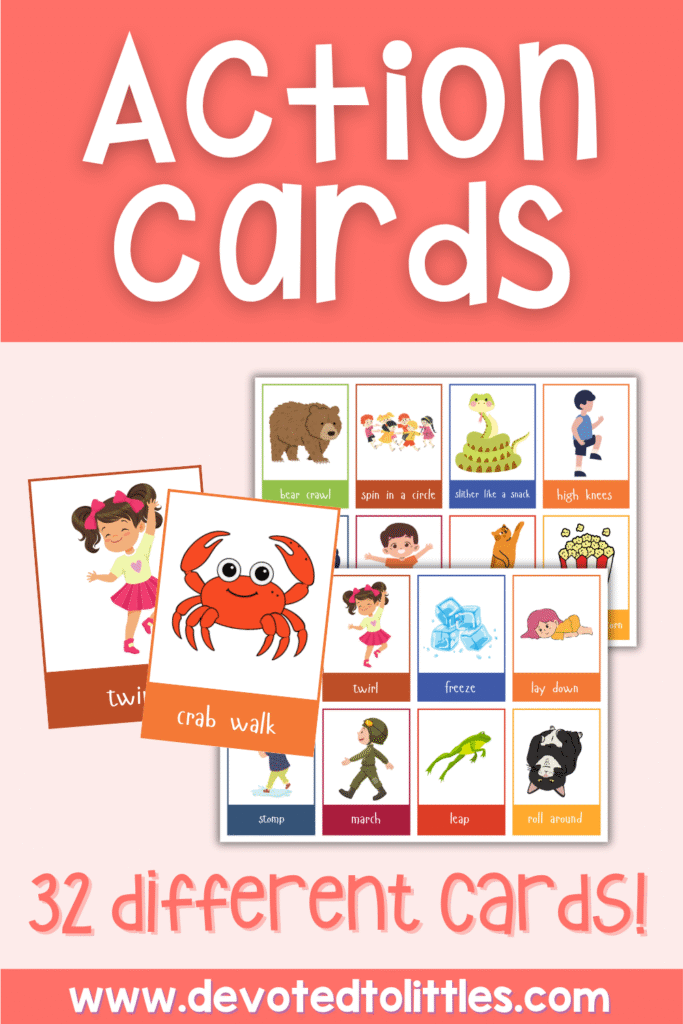
You can download my UPDATED printable Silly Voice and Action Cards for free by entering your email in the form below and I’ll send them straight to your mailbox!
Silly Voice and Action Cards
History
This week our history sentence is: During the Hundred Years’ War, Joan of Arc and King Charles VII led the French to defeat the English at the Siege of Orleans. In the late 1340s, fleas on rats carried the plague, which killed one out of three Europeans.
To help the kids learn this sentence in a fun way, we’ll play the “Silly Words” game again.
First, I’ll sing the history sentence correctly and ask the children to listen carefully (see my tutor video for this week’s tune). Then, I’ll sing it again but sneak in silly words. For example:
During the Hundred Tears’ War, Joan of Bark and King Charles the Pizza led the French to defeat the English at the Siege of Oreos. In the late 1340s, fleas on hats carried the plague, which killed one out of three Unicorns.
Whenever they hear something silly, the kids raise their hand and tell me the correct word. Each time they correct me, I go back and repeat the sentence correctly from the beginning until I get to the next silly word. This way the children hear the correct sentence many times while laughing and staying engaged.
Once all the silly words are fixed, we’ll stand up and march or dance around the room as we sing the history song together. The movement keeps their energy high and helps the memory work stick.
Science
This week in science we are learning about some important cycles in nature: the water cycle, the carbon and oxygen cycle, and the nitrogen cycle.
To begin, I’ll show the children each of these cycles on my tutor board and introduce a simple song to the tune of Skip to My Lou. Singing together gives them a fun way to start remembering the names of each cycle.
Next, we’ll play a game with cycles of nature cards and a dry erase die. I will have three columns drawn on the board, each labeled with one of the cycles. The cards will show an image of a part of one of the cycles along with its name.

Here’s how we’ll play:
- The kids will take turns rolling the die.
- If they roll Water Cycle, Carbon and Oxygen Cycle, or Nitrogen Cycle, they’ll choose a matching card and place it in the correct column on the board (using painters tape)
- If they roll Silly Voice or Fun Action, they’ll pick one and lead the class in singing the cycles of nature song that way (everyone joins in!).
- If they roll Sing the Song, the whole group sings the song normally.
We’ll keep playing until all of the cards are sorted into the correct columns. Once finished, we’ll look at the completed chart together and briefly talk about what each image represents. This quick discussion helps reinforce not only the cycle names but also the different parts of each one.
This activity combines music, movement, and visuals to keep the lesson interactive and memorable for even our youngest learners.
Latin
Our Latin memory work this week focuses on the first conjugation verb endings in the future tense:
-bō, bis, bit, bimus, bitis, bunt. See my tutor video for the tune we sing these to!
This week in Latin we’ll review the endings with a fun game of Duck, Duck, Goose—but with a twist! 🦅

We’ll sit in a circle and use Baldy, my eagle puppet, to tap each child gently on the head while we sing the Latin endings together. When the song ends, the last child tapped gets to take a turn holding the puppet. The child who just had a turn will sit back down in that spot, and the new puppet-holder will continue the game.
We’ll repeat until everyone has had a chance to use the puppet. This simple game keeps the kids engaged, gives them lots of repetition of the Latin endings, and adds a playful element that they always love.
Review
For review time this week, we’ll play a favorite game called Stop, Drop, Act Like a Rock!
Here’s how it works:
- The kids move around the room (walking, skipping, or dancing).
- When I call out, “Stop, Drop, Act Like a Rock!” they all freeze, drop down to the floor, and curl up like little rocks.
- I walk around, tap one of the “rocks,” and ask that child a review question. If they need help, the rest of the class can chime in.
- Once the question is answered, everyone gets up and starts moving again until I call out the phrase once more.
We’ll keep going until each child has had a turn to answer. This game is simple, silly, and full of movement—perfect for keeping little ones engaged while reviewing all the memory work.
I personally like to ask questions on the fly to keep things lively, but here are some example questions I’ll use with my Abecedarians:
- What is something God created and do you remember which day He created it on?
- What was one of the land biomes we learned about last week?
- Who did Pope Leo III crown Holy Roman Emperor?
- In 1054 what happened to the church?
- Do you remember the definition of a pronoun?
- What were some of the nominative pronouns we learned last week?
This game works beautifully because it mixes fun, suspense, and review! The kids don’t even realize how many times they’ve practiced the material!
Our NEW Cycle 2 Memory Work Activity Book
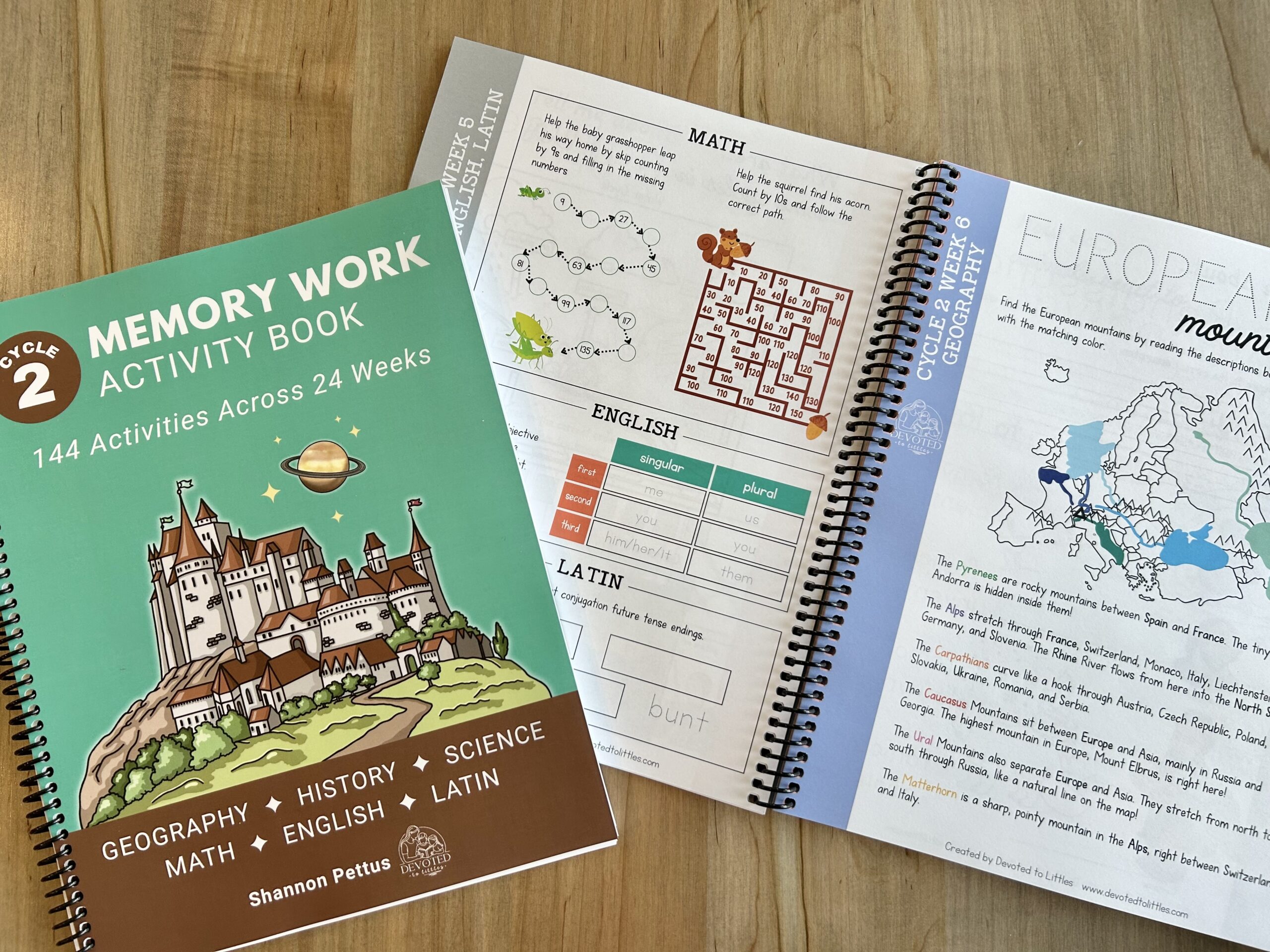
If you’re looking for a fun way to review the memory work at home with your kids this year, check out our NEW Cycle 2 Memory Work Activity Book. I created this notebook to give kids a fun way to practice their memory work, without adding extra prep for mom, dad, or grandma.
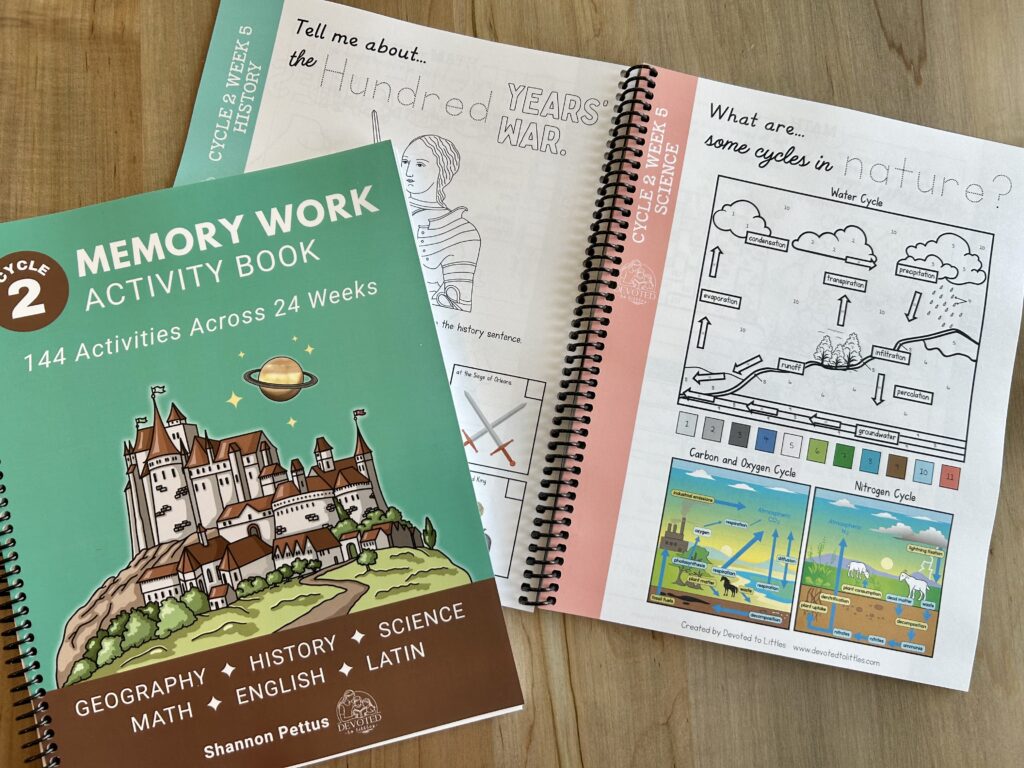
Inside, there’s one short activity for each subject for all 24 weeks of Cycle 2. When we do geography on Monday, they do the geography activity for that week. When we get to Thursday, they do the science page. It’s so easy to match to whatever we’re focusing on that day.
I love that it keeps things simple and fun. It’s NOW available in digital and printed form, and there is a sample page you can take a peek at if you would like too! Check it out below!
NEW Cycle 2 History and Science Placemats
These brand-new Cycle 2 History and Science Placemats are designed to make memory work fun and interactive for kids, whether you’re using them alongside Classical Conversations or on their own as a way to dive deeper into history and science.

Each placemat is filled with colorful visuals and simple explanations that bring the topics to life. Just print, laminate, and use them again and again during meals and review time. They’re an easy, no-prep way to dive deeper into the history and science topics with your kids. Get your set for the first six weeks below. Future weeks will be available soon!

Cycle 2 Pronoun Memory Cards
These Pronoun Memory Cards cover all 75 pronouns from Cycle 2, Weeks 4–13 and can be used in three different games. Each card includes a sentence, a colorful image, and the pronoun type, making it easy for kids to connect meaning with usage.
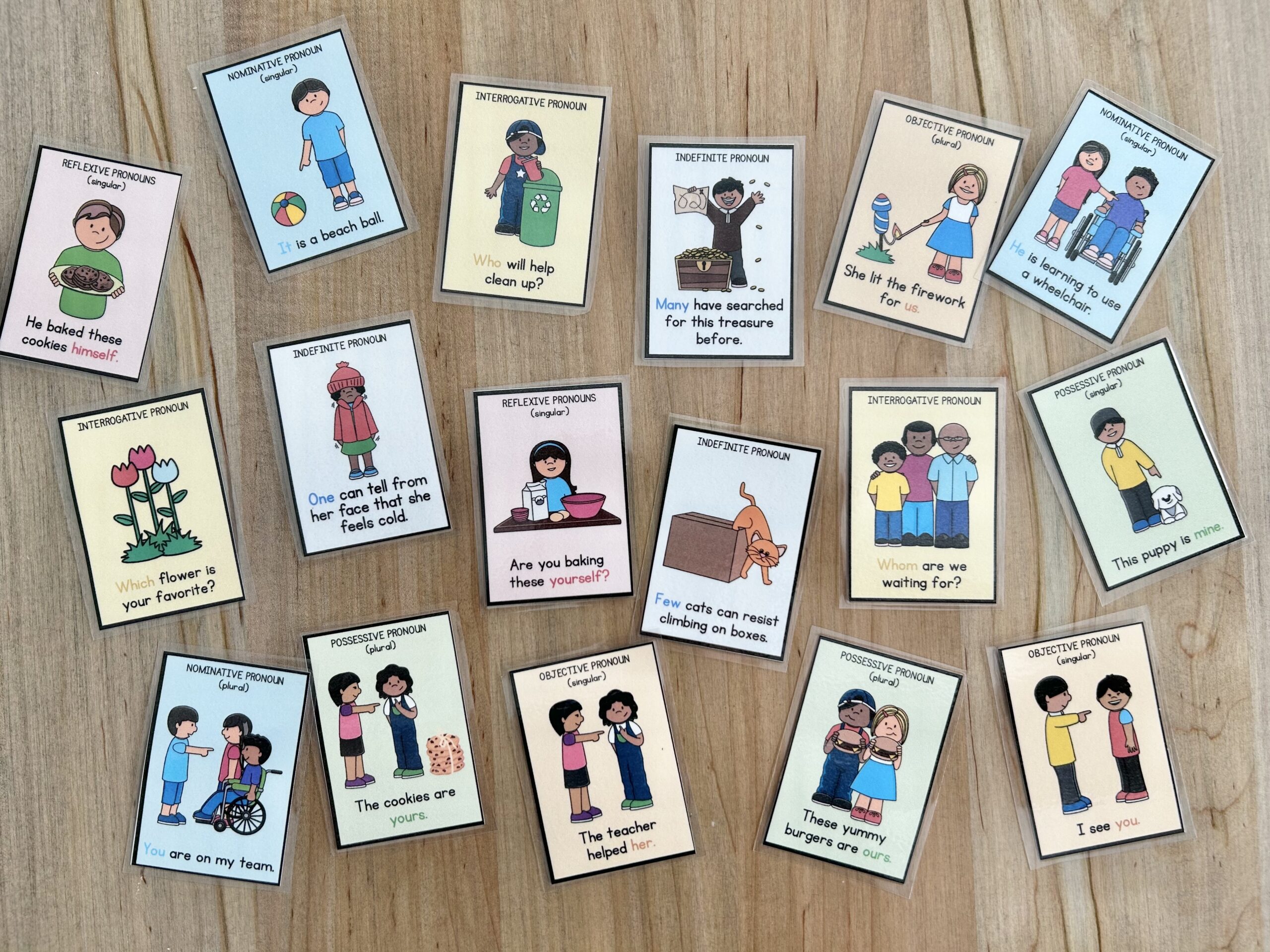
You can sort them by pronoun type, play a classic memory match, or try the fill-in-the-blank version for an extra challenge. My kids loved playing, and it gave them tons of practice without it feeling like drill. This set has quickly become one of our favorite go-to grammar review tools!
Cycle 2 Geography Passport
We also have a fun addition for geography review — the Cycle 2 Geography Passport! Whether you’re a tutor or a homeschool parent, this printable resource helps kids track their Classical Conversations Cycle 2 geography week by week with full-color maps and matching cut-and-glue stamps.
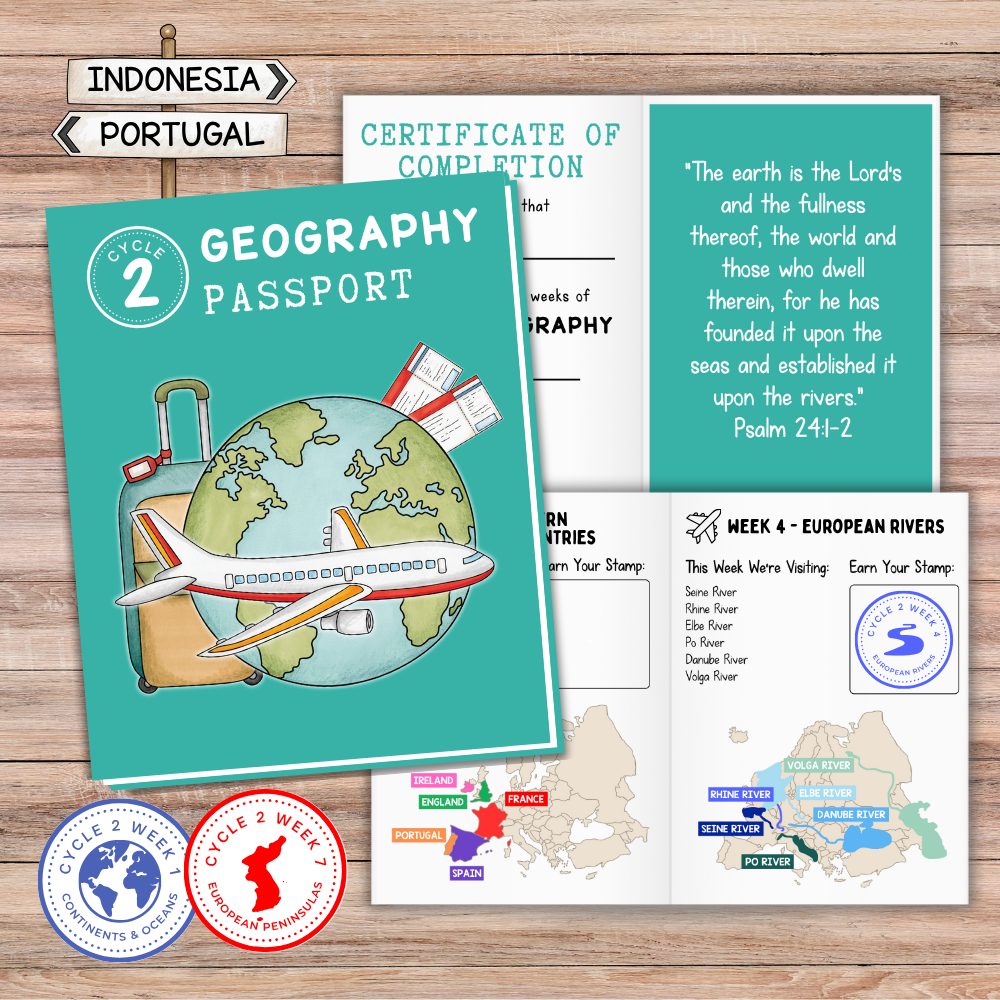
Each page highlights that week’s memory work with clearly labeled locations, making it easy for young learners to connect what they’re memorizing with what they see on the map. Kids love collecting stamps as they “travel” through the world. You can also print these stamps on these sticky circular labels which makes it even more fun!
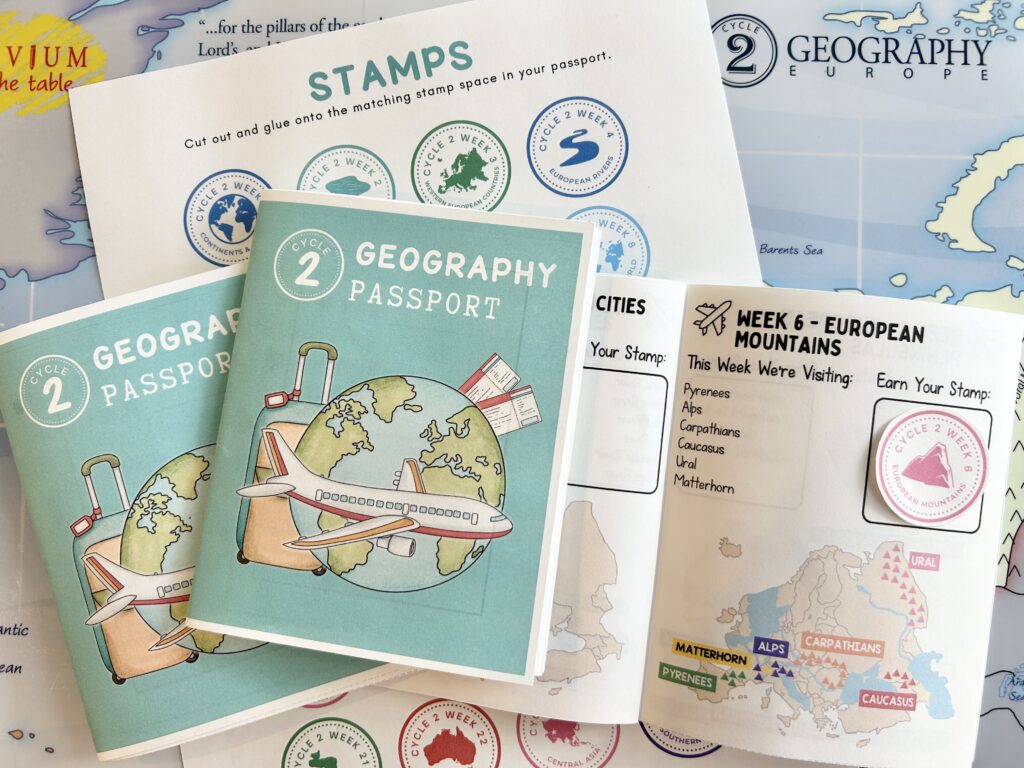
You can use the Geography Passport at home with your own children, or print it out for use in class. A group license option is available if you’d like to use it with your tutoring class or community group.
It pairs perfectly with the Cycle 2 Memory Work Activity Book, giving your students or children a hands-on, engaging way to practice their memory work all year long. If you’d like both resources, be sure to check out the bundle option available in my shop!
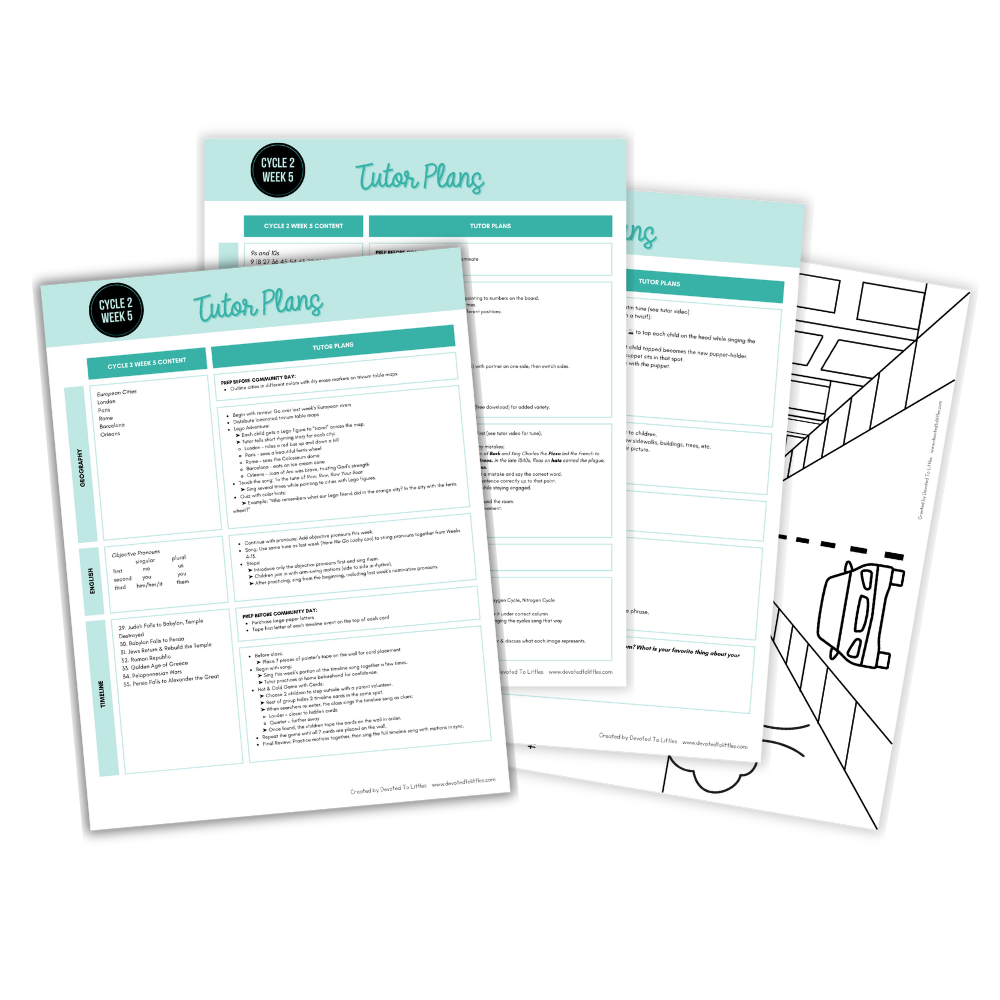
Printable and Editable Cycle 2 Week 5 Tutor Plans
Here is a printable EDITABLE template of these Cycle 2 Week 5 Tutor Plans. Here is a blank template too! If you want the plans as they are, here is a PDF version (filled out) and a PDF version (blank).
Cycle 2 Week 5 Memory Work Games
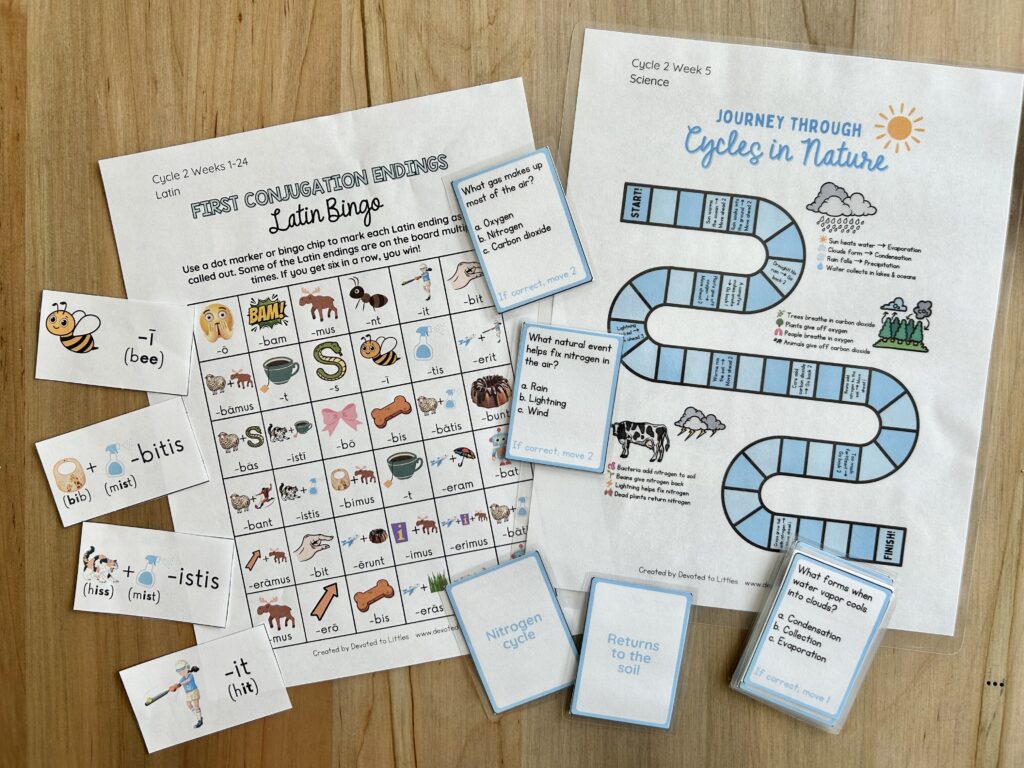
Also check out the FREE activities and games that you can use at home to help your kids practice the memory work this week.
I hope this helps give you some ideas and songs to use whether you are a tutor or a parent. Please comment below if you have any questions about anything.
Blessings to you on this homeschooling journey!